Yeshiva University







Skip past mobile menu to footer


YU News
Latest News
Featured News
Researchers, clinicians, engineers, industry leaders and students from around the world gathered at the Yeshiva University Museum from Oct. 19 to 21 for the IEEE International Conference on E-health Networking, Application & Services (HealthCom 2026), hosted by Yeshiva University’s Katz College…
At Katz College’s 2026 AI Demo Day, graduate students demonstrated nearly 30 projects that track antibiotic resistance, protect patient privacy, spot phishing emails, plan train trips and even help people find their keys.
Professor Fredy Zypman's new paper in the American Journal of Physics turns a classroom electromagnetism technique into a tool for measuring charge on microscopic particles.
Nurse and TikTok creator Miriam Ezagui inspires Katz College nursing students with lessons on the impact of nursing and balancing career and family.
The Katz College of Science and Health has awarded seven research grants for 2026-27 through its Faculty Research Initiative, supporting faculty projects in artificial intelligence, the health sciences and the life sciences. The projects range from an AI tool that could catch a serious heart and…
Tirth Joshi, a student in the Katz School’s M.S. in Artificial Intelligence, won Best Poster Award at Network Science Informs AI 2026, a satellite event of the NetSci Conference 2026, for developing a new way to shrink large collections of data while doing a better job of keeping the features that…
At the Katz School's 2026 Graduate Computer Science and Engineering Research Forum, Jelidah Nayingwa, a student in the Katz School's M.S. in Artificial Intelligence, presented research showing how AI can turn plain English questions into the code needed to retrieve information from hospital…
At the 2026 Symposium on Science, Technology and Health, Nicole Aziz, a student in the Katz School's M.S. in Speech-Language Pathology program, presented research that examines whether whispering truly harms the voice more than normal speech, challenging a long-standing recommendation in voice…
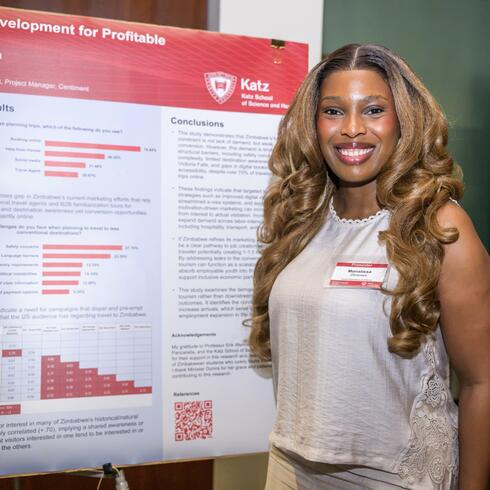
At the 2026 Symposium on Science, Technology and Health, Monalissa Zibwowa, a digital marketing student, presented research that examines how Zimbabwe can attract more visitors from the United States and use tourism growth to create jobs for young people.
A small amount of carefully designed noise could help computer models better capture the complex motion experienced by energy-harvesting devices in real-world environments, according to research presented by Penghui Han, a Ph.D. student in Mathematics at the Katz School.