

"We’re not building AI for its own sake. We’re building systems that solve real problems—problems in healthcare, security, education and daily life—where smarter technology can make a meaningful difference." — Dr. Honggang Wang

Honggang Wang
Department Chair and Professor
Graduate Computer Science and Engineering

Research Interests & Expertise
AI/ML, Multimedia Communications and Processing, Mobile Networks and Wireless Communications, Connected Health and Biomedical Devices, Cybersecurity and Internet of Things (IoT), Autonomous Vehicle Navigation and Safety
Dr. Honggang Wang
honggang.wang@yu.edu I 646-592-4763 I 205 Lexington Avenue, 7th FL, NYC
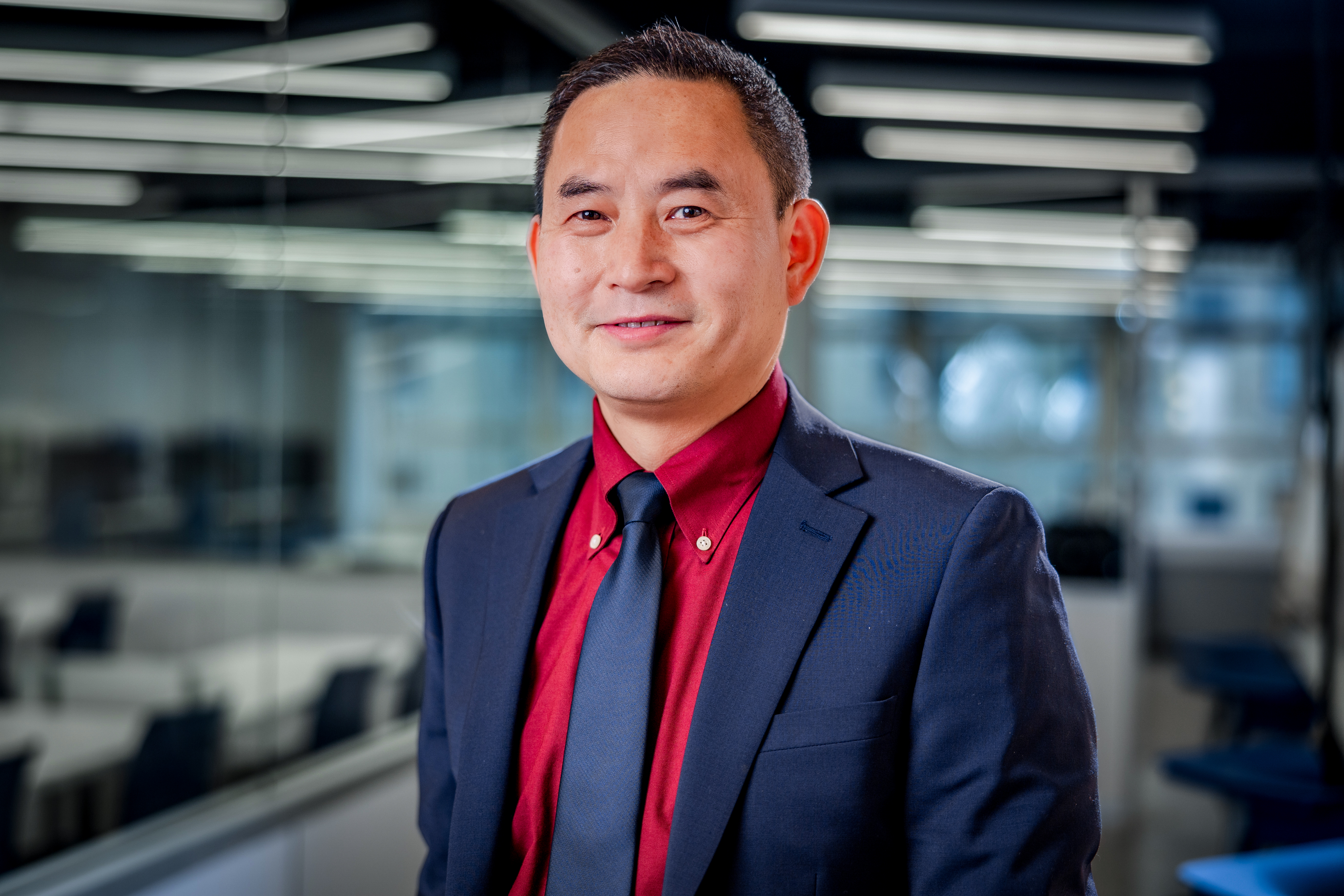
Dr. Honggang Wang is the founding chair of the Department of Graduate Computer Science and Engineering at the Katz School of Science and Health. His research focuses on artificial intelligence, wireless communication, and digital health, with an emphasis on technologies that support safer, more secure health and communication technologies.
He has received over $5 million in research funding from organizations such as the National Science Foundation, National Institutes of Health, and U.S. Department of Transportation. Current projects include developing autonomous vehicle navigation algorithms for detecting hazardous road conditions, and designing AI-powered wearable devices to monitor drug use and aid in disease detection. Previous work includes a portable, lightweight “intensive care unit” — a wearable biosensor system incorporating a wireless body area network that remotely monitors the physiology of infants to anticipate life-threatening events, such as Sudden Infant Death Syndrome.
An IEEE Fellow and IEEE Distinguished Lecturer, Dr. Wang received Outstanding Researcher and Leadership Awards from the IEEE Communications Society and served as chair of both the IEEE Technical Committee on Multimedia Communications and IEEE e-Health Technical Committee. Dr. Wang holds a Ph.D. in computer engineering from the University of Nebraska–Lincoln, along with an M.S. in computer science and engineering and a B.E. in electrical engineering from Southwest Jiaotong University in Chengdu, China.
Current Research
- AI-driven Wireless Communication and Networks
- AI algorithms for autonomous vehicles that detect hazardous road conditions
- Wearable devices that use machine learning to monitor drug use and support disease detection
- Digital health systems integrating wireless body area networks


Recent Publications
- MambaVoiceCloning: Efficient and Expressive Text-to-Speech via State-Space Modeling and Diffusion Control (ICLR, 2026)
- Concurrent Wireless Power Transfer in the Internet of Batteryless Things: Experiment and Modeling (IEEE transactions on Mobile Computing, 2025)
- Wireless Health (2016, Springer) — foundational book on connected health and wearable systems
- An overview of wireless body area networks for mobile health applications (2023, IEEE Network)
- Generative AI-Based Difficulty Level Design of Serious Games for Stroke Rehabilitation (2024, IEEE Internet of Things Journal)
- Machine-learning-enabled cooperative perception for connected autonomous vehicles: Challenges and opportunities (2021, IEEE Network)
- Internet of Things for in-home health monitoring systems: Current advances, challenges and future directions (2021, IEEE Journal on Selected Areas in Communications)
- GGCNN: An Efficiency-Maximizing Gated Graph Convolutional Neural Network Architecture for Automatic Modulation Identification (2023, IEEE Transactions on Wireless Communications)
- See full list of publications on Google Scholar
Editorial Roles
- Editor-in-Chief, IEEE Transactions on Multimedia (effective January 2026)
- Editor-in-Chief, IEEE Internet of Things (IoT) Journal (2020–2022)
- Editor-at-Large, IEEE Transactions on Network Science and Engineering
- Associate Editor, ACM Transactions on Computing for Healthcare (2023–present)
- Deputy Editor-in-Chief, IET Communications
Awards and Honors
- IEEE Fellow
- IEEE Distinguished Lecturer
- Best Paper Award, IEEE International Conference on Computing, Networking and Communications
- Outstanding Researcher Award, IEEE Communications Society
- Outstanding Leadership Award, IEEE Communications Society
Industry Collaborations
- Partnerships across autonomous systems research
- Consulting and advisory roles in digital health and emerging wireless technologies
- Former chair, IEEE Technical Committee on Multimedia Communications
- Former chair, IEEE e-Health Technical Committee
Media and Speaking
- IEEE Distinguished Lecturer talks on AI, IoT, and digital health
- Frequent invited speaker at conferences on wireless systems, mobile computing, and autonomous technology