By Dave DeFusco
Artificial intelligence is everywhere right now. It writes emails, summarizes documents, creates images and answers questions in seconds. For many people, that sudden visibility raises big questions: Will AI replace my job? Can I trust what it tells me? Is this real progress or just hype?
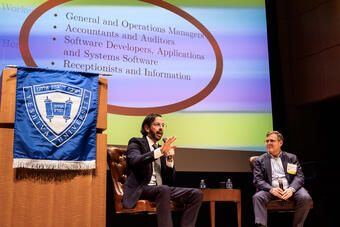
Those questions were at the heart of a recent program on “Separating Science from Fiction: What AI Means for Jobs, Growth and the Economy,” at the YU Museum in November. Sponsored by the Sy Syms School of Business, Katz School of Science and Health and YU Office of Alumni Affairs, the event featured a wide-ranging conversation between two experts who have spent decades studying, building and questioning artificial intelligence.
Dr. David Magerman, a renowned computer scientist with a Ph.D. from Stanford University and more than 25 years of experience in AI and data science, began by addressing a common misconception. “I’ve been doing AI for a long time,” he said. “People today think AI was started five years ago, but that’s just not true.”
He explained that artificial intelligence as a field dates back to the 1950s and 1960s, when early computer scientists began asking whether machines could mimic human thinking. One famous early example was a simple program called ELIZA, which imitated a therapist by repeating and reframing users’ words. Though the technology was basic, people were amazed.
“It looked like it was actually human,” said Magerman. “People were ready to say, ‘We’ve got artificial intelligence like a human.’ Obviously, it was oversold.”
That cycle—big excitement followed by disappointment—has repeated itself throughout AI’s history. Over time, many successful AI tools stopped being called AI. “Google search is probably the most valuable piece of AI ever created,” said Magerman. “We don’t call it AI anymore. It just works.”
Dr. Pablo Hernandez-Lagos, director of the Sy Syms MBA program and a leading scholar at the intersection of AI and the global economy, built on that idea. He emphasized that what the public sees today—tools like ChatGPT—is only a small part of a very large field.
“This is the result of thousands of scientists writing thousands of papers,” said Hernandez-Lagos. “What we are seeing now is just the tip of the iceberg.”
He explained that recent breakthroughs, including neural networks and a technique called the "transformer," made AI tools faster and more commercially appealing, but there is a psychological reason this moment feels different.
“When AI imitates humans, we get the chills,” said Hernandez-Lagos. “But imitation does not mean intelligence.”
Magerman warned that AI companies often impress the public with flashy demonstrations that don’t reflect real-world usefulness. “There’s a reason every robotics demo you ever see is playing soccer or dancing,” he said. “Those things look amazing, but they’re not very useful in industry.”
Companies, however, continue to promote these systems as nearly finished products. According to Magerman, this gap between marketing and reality fuels public confusion. Audience members asked whether today’s AI boom resembles the early days of the internet. Both speakers agreed there is a bubble, but not the same kind.
“The internet was infrastructure,” said Magerman. “AI is an application.”
While the internet created a foundation that transformed society even after the dot-com crash, Magerman argued that today’s AI hype is driven by tools that are expensive, inefficient and often misused. “We’re using a sledgehammer to push in a thumbtack,” he said.
Hernandez-Lagos added that massive corporate spending makes AI seem unstoppable, but much of that money, he said, circulates within a small group of tech firms, inflating stock prices without clearly benefiting the broader economy. "One company today spends more on AI than entire countries spend on research and development," he said.
The conversation then turned to the issue many in the audience cared about most: employment. Hernandez-Lagos summarized current research on AI and jobs. “So far, the overall effect is very small,” he said. “Some entry-level positions, such as accounting, software development and clerical roles, are more exposed to automation, but the impact is limited.”
The key factor, he said, is expertise. “Those who are experts actually receive a compensation bump,” said Hernandez-Lagos. “If you are an expert, AI becomes a tool that helps you. If you are not, it may not help you at all.”
Magerman added that recent tech layoffs were often blamed on AI, but the reality was more mundane. He also warned that replacing junior workers with AI could create long-term problems. “Companies overhired and AI became a convenient story to mask cost-cutting,” he said. “If entry-level employees don’t do the work, how do you know who to promote?”
Hernandez-Lagos shared research showing that widespread AI use can actually make hiring harder. When everyone uses AI to polish resumes and applications, it becomes more difficult to tell who truly has expertise. For highly skilled candidates whose first language is not English, however, AI can help real expertise stand out rather than be hidden by language barriers.
As the evening drew to a close, the conversation widened to ethics, responsibility and values. Magerman spoke about the importance of constrained capitalism and building technology that serves humanity, not just profit. Hernandez-Lagos echoed that sentiment, acknowledging the tension between innovation and responsibility.
"We live in a world driven by incentives," he said, "but character and trust still matter."