
On July 30, Katz College's Department of Graduate Computer Science and Engineering hosted AI Demo Day, where graduate students didn't just describe their ideas, they showed them at work. Across two sessions chaired by Dr. Joshua Rumbut, professor of artificial intelligence, students demonstrated nearly 30 projects that track antibiotic resistance, protect patient privacy, spot phishing emails, plan train trips and even help people find their keys.
"AI Demo Day is a highlight of our capstone season, and it shows what's possible when a department and a school commit fully to AI," said Dr. Honggang Wang, chair of the Department of Graduate Computer Science and Engineering. "With strong support from Katz College, our students have the mentorship, tools and freedom to experiment and build systems like these, not someday, but now."
“The field is moving past AI that simply answers questions toward systems that plan, act and check their own work,” said Dr. Julia Fang, director of the M.S. in Artificial Intelligence. Our students built safety and verification into the design, with answers grounded in real data and people kept in the loop. That is the cutting edge of the field, and they're working right at it.”
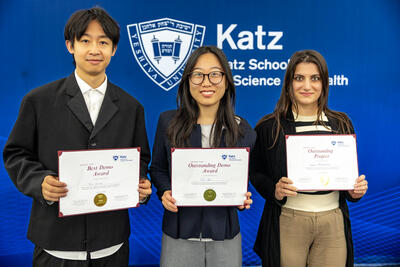
Four projects earned top honors:
- Xin Xiang won the Best Demo Award for RoomTwin, which turns a single scan of a room into a photorealistic, interactive digital twin on the Quest 3 headset. Users can pick up and move objects, which behave realistically, and a virtual assistant can guide them to any object they name.
- Miriam Tuchman won Best Project for ResistanceX. Antibiotic resistance kills more than 1 million people a year, and the genes that make bacteria resistant can jump from one species to another. Drawing from three live public databases, ResistanceX lets users enter a gene name or DNA sequence and see how the gene works, where it has spread and what recent research says.
- Jiuge Ren received the Outstanding Demo Award for Long Weekend Trip Planner, which uses Google's Gemini model to build personalized getaways around Amtrak and regional rail, complete with local events, packing tips and the history behind each stop.
- Laura Ibragimova earned the Outstanding Project Award for The Policy Nest, which turns dense Medicare and Medicaid value-based care requirements into step-by-step project plans for healthcare organizations without dedicated compliance teams.
Healthcare was one of the day's strongest themes. Mehluli Nokwara built an agent that matches patients to clinical trials and explains the evidence behind each match. Nokwara also teamed with David Portnoy on PrivacyGate MCP, which keeps protected health information on local machines and redacts personal details before anything reaches an outside AI model.
Tinashe Chidarikire, Primrose Tivatyi and Precious Chimperu are developing a recipe app that uses USDA nutrition data to steer users toward healthier meals. Closer to home, Farhat Jahan and Wadzanai Chawatama each built inventory systems for Katz College's nursing simulation lab. Jahan's tracks every item with QR labels, and Chawatama's lets users search for supplies by procedure.
Many projects addressed a central question: How can people trust what AI tells them? Abhishek Sharma's Phishing Email Analyzer gives ordinary users a plain-English verdict on a suspicious email. Akachukwe James Okoli presented CyberSentinel, an AI-powered threat intelligence platform, and Ngonidzashe Tsimba's GovernAI would help organizations manage AI risk and compliance.
Several students built teams of AI agents that check one another's work. Aaron Herbert's ApplyAgent drafts resumes and cover letters but sends nothing without human approval. In David Li's ML Tutor Council and Jakob Berger's Brain Wiki Navigator, verifier agents confirm that every source the AI cites actually exists.
Other students made data easier to question in plain English. Aaron Herbert built the Tournament Intelligence Engine, which answers questions about the 2018 and 2022 FIFA World Cups from 462,000 real match events. FNU Himanshi's NYC 311 Smart Complaint Explorer with AI tool searches millions of NYC 311 complaints by meaning rather than keywords, and Alwyn Munatsi and Erasmus Tsuro's PourSight lets small restaurant managers ask whether, say, football matches boost sales.
Johanna Sarai Caicedo Mejia compared techniques for reducing AI errors on dense technical documents in Comparative Analysis of Advanced Retrieval-Augmented Generation Architectures on Unstructured Technical Datasets, and Alex (Xiaoyu) Ji and Loredana Levitchi presented Orallexa Shadow, a multi-agent platform for cryptographically verifiable financial intelligence.
Everyday life got attention, too. Ken Mudzingwa, Talic Tadiwanashe Magwere and Takudzwanashe Kuipa built PlantPulse, a houseplant care assistant. Tatiana Nyanhongo and Bakar Tsobekhia built movie recommenders that understand meaning. Asked for films like “Departures,” Tsobekhia's CineSage suggested other films about grief rather than simply other Japanese titles. Dhiransh Saxena's MTG Vault identifies Magic: The Gathering cards by camera, and Simbarashe Mukanganwa's Savora helps students find campus meals while reducing food waste. Miriam Tuchman also built ClutterLens, an augmented reality assistant that remembers past scans so users can later ask, “Where are my keys?”
David Li, who built the ML Tutor Council, also presented three research projects: ResidueSeg, a mathematical approach to image segmentation that cut certain errors by as much as fifteenfold; RiskSwitch, which keeps a trading desk's risk calculations fast at the scale of millions of trades; and a method in which AI proposes new programming-language commands that are accepted only with mathematical proof that they follow the domain's rules.
“An AI model on its own is only as good as what it remembers, and that isn't enough when accuracy matters,” said Rumbut. “Grounding the model in real data and testing it rigorously is what separates a clever demo from a system people can rely on.”


