
Measuring the electric charge on a particle smaller than a bacterium remains a challenge in modern science. In a paper in the American Journal of Physics, Katz College of Science and Health Professor of Applied Physics Fredy R. Zypman connects this research problem with classroom learning. His work shows how a central idea in electromagnetism can help explain measurements at microscopic scales. The results have been used to teach both graduate and undergraduate students, giving them a direct connection between the physics that they study, and unanswered questions in foundational research.
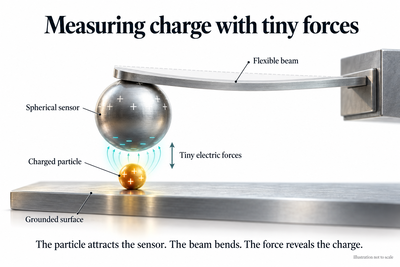
The instrument at the center of the study is the atomic force microscope. It uses a tiny, flexible beam carrying a sensor to detect extremely small forces. As the sensor approaches an electrically charged particle, an attraction force bends the beam. Recording how this force changes with distance provides clues about the particle’s charge. Turning those measurements into useful information requires a mathematical description of how the particle, sensor and support surface interact.
Zypman develops the mathematical model using the method of images, a technique students encounter in electromagnetism courses at Katz College. The idea is to replace the complicated redistribution of charge on conducting surfaces with imaginary charges placed at carefully chosen locations. In this study, a spherical sensor and a flat supporting surface require an infinite sequence of such images. Their combined effects yield a prediction of the force as the sensor approaches the particle. Comparing that prediction with experimental measurements offers a way to estimate the particle’s charge magnitude and size.
The model is built around the experimental setting to address a current research question while remaining manageable for students. It gives abstract mathematics a physical purpose: understanding what a laboratory instrument measures. Students can follow the reasoning, explore the calculations, and see how practical assumptions make a difficult problem tractable. They can also consider how the model could be extended to address other situations, opening up opportunities to ask their own questions and potentially engage in further research.
This blend of research and teaching gives students access to scientific inquiry through concepts that they are already learning in the classroom. Undergraduate and graduate instruction can draw on the same problem at different levels of depth. By connecting a classroom technique with the ongoing challenge of measuring electric charge, the work offers students a concrete route from understanding established physics to exploring questions that remain open.
Fredy Zypman, Ph.D. is a professor of applied physics at Katz College of Science and Health at Yeshiva University. He received his degrees in Uruguay (B.S. in Engineering), Venezuela (License in Physics) and USA (Ph.D. in Applied Physics). Before joining Katz College, he taught for many years at the University of Puerto Rico. In addition to his work in academia, he has consulted on instrumentation for the medical and energy industry.


