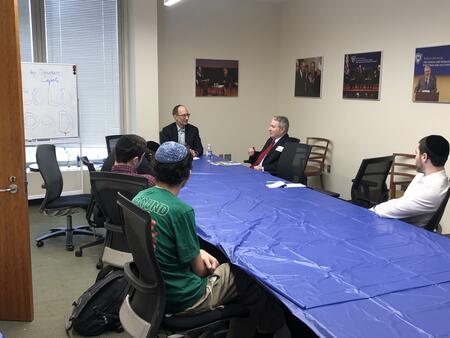
On April 13, 2026, the Zahava and Moshael J. Straus Center for Torah and Western Thought, in conjunction with the Jay and Jeanie Schottenstein Honors Program, hosted Dr. Carl Richard to discuss his book So Help Us, God: American Presidents and the Bible and the role scripture has played in shaping the United States presidency. The conversation was moderated by Straus Center Senior Scholar Dr. Tevi Troy.
Dr. Richard, a professor of history at the University of Louisiana at Lafayette, began the lecture by comparing how the American Founders interacted with Western classics and the Bible. While classics were mostly taught to upper-class boys as part of their education, familiarity with the Bible was much more common among the general population in colonial and revolutionary America. It was taught to both girls and boys in schools of all classes and was, of course, heavily referenced by preachers during their speeches from the pulpit. Dr. Richard noted that these speeches were quite popular and long, creating an environment with strong exposure and familiarity with the Bible.
With the Bible as the common parlance of the time, shaping language, culture and values, the American Founders and presidents frequently referenced it in their public and private speeches and communications, both because they themselves were familiar with it and because the citizenry was. This throughline continued from George Washington until George W. Bush.
Following the Bush presidency and the election of Barack Obama, Dr. Richard described a change in how the presidency interacted with the Bible. Obama, Dr. Richard said, had a “complicated” relationship with scripture during his time in the White House. Before his election, he attended Jeremiah Wright’s church for 20 years and derived certain principles that he attributes to his time with Wright, but he also wrote in his memoir A Promised Land that he was ambivalent about the Church. Still, Dr. Richard argued that there were some biblical influences in the Obama presidency. For Donald Trump and Joe Biden, however, Dr. Richard did not “see much biblical influence there at all,” arguing that this is a reflection of where America is as a society and the declining rates of biblical literacy among the general population.
However, despite his lack of biblical knowledge, Trump still maintains a high level of Evangelical support. Dr. Richard attributed this to Evangelical fear of the secular left, making a case that Evangelical votes were a “compromise” many voters felt they had to make. At the same time, Trump promised to deliver on issues that are important to Evangelicals during the campaign, and has followed through on several of those promises. Dr. Richard also noted that Trump does not pretend to be familiar with the Bible, referencing an instance when Trump referred to “Second Corinthians” as “Two Corinthians,” which perhaps makes it easier for Evangelicals to vote for him as a purely utilitarian candidate rather than someone who represents their faith.
Following the main presentation, Dr. Troy moderated a student Q&A on the various definitions of Christian Nationalism, the similarities between Orthodox Jews and Evangelical Christians and the future of classics education.
Subscribe to the Straus Center newsletter to stay up to date on the latest Straus Center events, publications and news. Click here to sign up.
To learn more about the Straus Center, click here. And be sure to like the Straus Center on Facebook, follow us on Twitter and Instagram, and connect with us on LinkedIn.