By Dave DeFusco
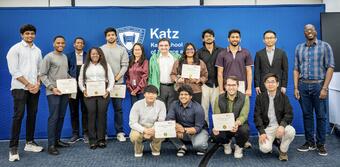
On April 30, the Katz School’s Department of Graduate Computer Science and Engineering became a showcase of how today’s most advanced technologies can tackle real-world problems. Graduate students presented research spanning artificial intelligence, cybersecurity, healthcare and data analytics—projects that ranged from predicting hit songs and detecting cyberattacks to diagnosing childhood illness and translating sign language in real time. While the tools behind the work were complex, the purpose was clear: to build practical solutions that make systems safer, decisions smarter and technology more accessible to people everywhere.
“Our students aren’t just learning concepts,” said Ming Ma, an assistant professor in the Graduate Department of Computer Science and Engineering. “They are building systems that can improve healthcare, strengthen security and make technology more accessible.”
One project, called Musical DNA, explored a question many people have wondered about: what makes a song successful? Benjamin Morris, a student in the M.S. in Data Analytics and Visualization, built a system that tries to predict how well songs will perform on streaming platforms. Instead of looking at just a few musical features, his model examined more than 700 factors, including lyrics, song structure and listening patterns. By combining all this information, the system became much more accurate, reducing prediction errors to approximately 4%. The goal wasn’t just prediction, however; the project also revealed patterns that artists and producers could use to make better decisions about their music.
Tendai Nemure, a student in the M.S. in Cybersecurity, tackled a very different challenge: how to protect companies using advanced AI systems. Today, many organizations rely on large language models—AI systems that can read and write text—to help analyze security alerts, but Nemure showed that these systems can be tricked. By inserting misleading information into a company’s knowledge base, an attacker could quietly influence how the AI thinks, potentially causing it to ignore serious threats. To address this, Nemure designed a layered defense system that checks for signs of manipulation before decisions are made. The system combines pattern detection, behavior analysis and a second AI “reviewer” to flag suspicious activity. The result is a more reliable way to keep organizations safe in an era when even the tools meant to protect us can be targeted.
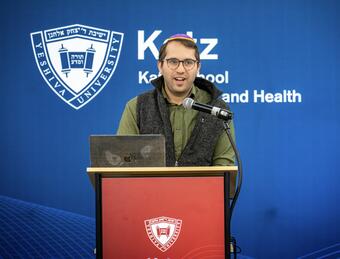
Healthcare emerged as one of the strongest themes of the showcase. Tadiwa Chiremba, a student in the M.S. in Artificial Intelligence, developed a tool to help diagnose lung conditions in children using sound recordings. In many rural areas, especially in parts of Africa, access to trained doctors and medical equipment is limited. Chiremba’s system uses a lightweight AI model to analyze lung sounds and identify signs of illness. Even in its early stages, the system showed promising results, correctly identifying abnormal sounds with strong accuracy. The long-term goal is to run this technology on small, affordable devices that can be used in remote clinics.
Another healthcare-focused project by Mehluli Nokwara, an artificial intelligence student, addressed a different problem: knowing when AI systems are unsure. In medical settings, overconfidence can be dangerous. Nokwara developed a method to measure how uncertain an AI model is when answering clinical questions. By analyzing patterns in the model’s responses, the system can decide when it’s better not to give an answer at all. This kind of “knowing what you don’t know” is essential for building safer AI tools in medicine.
Shivendra Gupta and Eesha Reddy Alluri, both students in the M.S. in Artificial Intelligence, also focused on healthcare research. Their project helps speed up cancer study reviews, a process that traditionally requires researchers to spend months reading and organizing thousands of scientific papers. Their AI-assisted system can take a medical question written in plain language, search research databases for relevant studies and summarize findings into organized evidence tables. As important, human researchers still remain involved in reviewing the results. By reducing repetitive tasks, the project could help cancer researchers and doctors analyze evidence quicker while maintaining scientific rigor.
Pranav Kumar explored another critical healthcare challenge: protecting patient privacy. His project, AI-Powered Continuous HIPAA, created a system that constantly monitors hospital networks and data systems for potential privacy or security problems. Instead of relying on occasional manual reviews, the platform uses AI to automatically connect healthcare regulations with technical system activity and quickly identify unusual behavior that could signal a breach. The system demonstrates how AI could help hospitals respond faster to security threats while improving compliance with healthcare privacy laws.
Cybersecurity student Tafara Magumise examined how digital health records can be protected in fragile regions such as Somaliland, where healthcare systems may face unreliable infrastructure and limited resources. His research explored how blockchain technology could improve trust, accountability and security in medical record systems. The project focused on practical safeguards such as access controls, data tracking and protection against tampering, showing how cybersecurity can support patient care and institutional trust even in difficult environments.
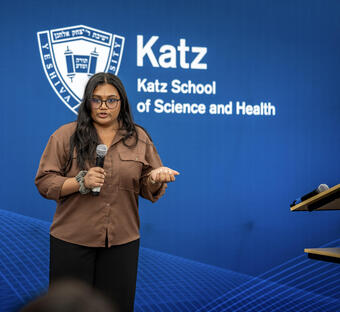
Cybersecurity remained a major theme throughout the event. Daniel Lodi introduced Defenstra, a platform designed to help small and mid-sized businesses understand their security risks. Many smaller organizations lack the resources to hire experts, leaving them vulnerable to attacks. Defenstra combines questionnaires, public data and threat intelligence to create a clear, prioritized risk profile. Instead of overwhelming users with technical details, it offers practical, low-cost steps to improve security.
Protecting vulnerable users online was another major focus. Rudo Zenda, Nathan Isheanesu Nyabvure and Rufaro Mahere, all students in the M.S. in Cybersecurity, created a browser extension designed to detect potentially dangerous grooming behavior on Roblox, a gaming platform widely used by children and teenagers. Their system monitors conversations in real time and searches for warning signs such as manipulation, secrecy or escalating inappropriate behavior. To protect privacy, the analysis happens directly on the user’s device rather than sending messages to the cloud. The project reflects how cybersecurity increasingly involves protecting people and communities, not just computer systems.
Other students explored how AI could improve learning and communication. Data analytics student Brighton Mukundwi worked on a real-time sign language translation system that uses a standard camera to interpret gestures and convert them into spoken or written language. By avoiding expensive hardware, the system could be used in a wide range of settings, making communication more accessible.
Meanwhile, computer science student Ngoni Shaani’s ZimEdu platform focused on education itself. The system helps teachers align lesson plans and materials with official curriculum standards, reducing preparation time while improving consistency. It shows how AI can support educators, not replace them, by handling repetitive tasks and allowing teachers to focus on teaching.
A project called TechBuddy by artificial intelligence student Gregory Schwartz addressed a growing digital divide. As technology becomes more central to everyday life, many older adults struggle to keep up. TechBuddy is designed to act on behalf of users by solving problems like fixing a printer or setting up Wi-Fi without requiring step-by-step instructions. The goal is to restore a sense of independence and confidence.
Artificial intelligence students Vishal Balaji and Gunal Karthikeyan Saravanan focused on workplace compliance and the growing problem of AI-generated misinformation. Their "Automated HR Compliance System" was designed to help organizations review employee policies accurately. Because AI systems can sometimes generate incorrect answers with confidence, the students built safeguards that verify AI-generated responses against official policy documents before information is shared with employees. The project highlights the importance of building AI systems that are both efficient and trustworthy.
Another artificial intelligence student, Jeldiah Nayingwa, focused on helping healthcare organizations manage complicated databases. His project, SAGE-SQL, allows users to describe a report in plain English, while the AI automatically generates the database code needed to retrieve the information. In large healthcare systems, building these reports manually can require deep technical expertise and significant time. By automating much of the process, the system could help hospitals and public health agencies access critical data more quickly.
Retail and business planning also found a place in the showcase. Artificial intelligence student Ranjith James developed PRISM, a platform that helps companies decide which promotions and discounts are most likely to succeed. Retail businesses often rely on incomplete data or guesswork when planning sales campaigns. PRISM combines AI models with data analysis tools to estimate which promotions are likely to generate the strongest results while staying within budget. The platform also explains why certain recommendations are made, helping users better understand the reasoning behind the AI’s suggestions.
Meanwhile, Dheeraj Chowdary Anne and Pravallika Reddy Sabbasani tackled a common workplace frustration: expense reporting. Their project, Expense AI, uses AI-powered systems to automatically read receipts, check company spending policies and generate reports. Instead of relying on rigid templates, the system can adapt to different receipt formats and company rules. If the AI encounters unclear or suspicious information, the case is flagged for human review. The project demonstrates how AI can reduce repetitive office work while still keeping people involved in important decisions.
Some projects pushed the boundaries of what AI can do. Artificial intelligence students Vinod Kumar and Hyeonwook Kim created RoboMascot, which connects language, video generation and robotics to create expressive movements in a humanoid robot. Others, like Vibex, created by Xiaoyu Ji, a student in the M.S. in Computer Science, showed how people can build software simply by describing what they want in natural language, lowering the barrier to entry for programming.
Despite the variety of topics, a common thread ran through all the work: the desire to make complex systems more useful, more understandable and more human-centered. The presentations were a glimpse into the future—one shaped by students who are not only learning how technology works, but asking how it should be used.
“These students were solving real problems,” said Honggang Wang, chair of the Graduate Department of Computer Science and Engineering. “They were building tools to help doctors, protect businesses, support teachers and connect people. Perhaps most important, they were showing that behind every line of code is a human intention: to make life a little easier, a little safer and a little better.”