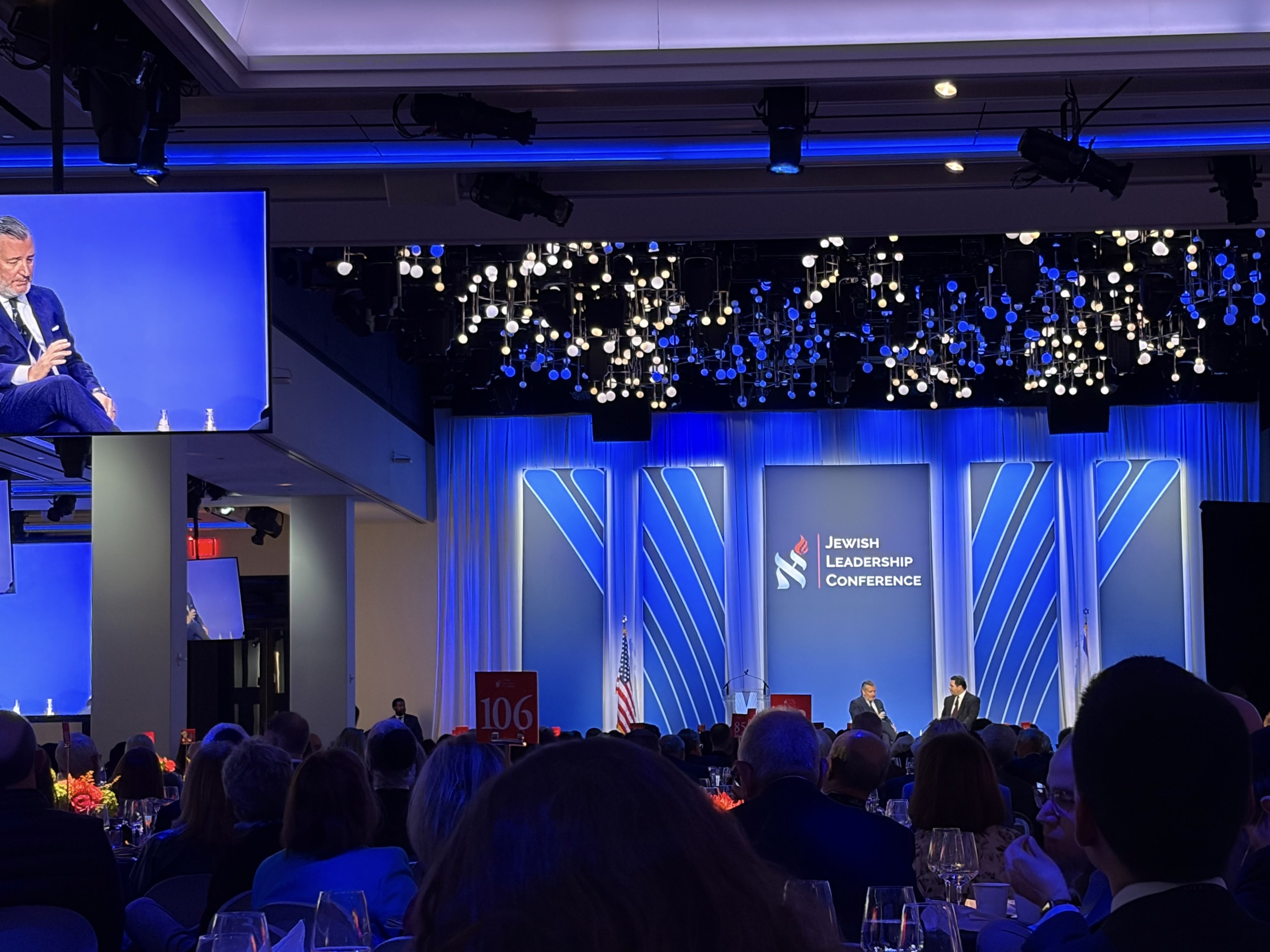
Straus Scholar Elisha Price (YC '28) reflects on his experience at Tikvah's Jewish Leadership Conference.
I was privileged to be among the cohort of students invited by the Straus Center to attend Tikvah's Jewish Leadership Conference on November 15, 2026, an annual gathering of intellectuals, educators, and political leaders from across the American Jewish community to discuss Jewish identity, American politics, and the future of Western civilization. In many ways, the conference was a natural extension of the Straus Center’s mission, bringing the intellectual questions we explore in our studies into contemporary public discourse.
The day began bright and early with Professor Ruth Wisse’s presentation on moral stamina, which drew on Sholom Aleichem’s Tevye the Dairyman to explore how Jews maintain their convictions amid the pressures of assimilation and accommodation.
The subsequent panel with Andrew Roberts, Michael Doran, and Aaron MacLean broadened the discussion to the challenges facing Western civilization. The conversation was personally exciting: I had studied with MacLean over the summer at the Hudson Institute Political Studies program, where Doran also led a session. They addressed the historical and geopolitical challenges facing the West, from external adversaries to the divisions emerging within Western societies themselves. Though both expressed somber assessments on the state of the modern West, they also maintained a degree of optimism about the West’s capacity for renewal.
Philosopher and author Micah Goodman’s presentation turned to the philosophical foundations of the Hebrew Bible’s contribution to Western civilization. He examined the tension between universalism and particularism: on one hand, the belief in the equal dignity of all human beings, and on the other, particular attachments to one’s people, land, and national tradition. Drawing on the Bible’s accounts of Creation and the Exodus, Goodman argued that these ideas are not competing principles but are rooted in the same intellectual and religious tradition. Goodman’s presentation touched directly on one of the central concerns of our studies at the Straus Center: the relationship between Torah and Western thought. Goodman’s talk brought to mind an upcoming book by Rabbi Dr. Stuart Halpern, Deputy Director of the Straus Center, titled Two Nations Under God: How (Biblical) Israel Inspires the United States, on which I worked last spring. Rabbi Dr. Halpern explores the biblical and Jewish foundations of American political thought from a different angle than Goodman. However, both of their arguments challenge the tendency to treat Jewish and Western intellectual traditions as distinct or competing inheritances. The relationship between these traditions would reappear in a more explicitly political context during Senator Ted Cruz’s later remarks.
The morning’s sessions were followed by a student symposium led by Dan Senor, in which Tikvah students and alumni discussed the books and ideas that had shaped their intellectual development and their sense of responsibility to the Jewish people and American society. It was a pleasure to see Officer Michael Smits among the presenters; several of us from the Straus Center had gotten to know him during our Operation Benjamin mission this past summer. Smits’s call for greater Jewish engagement in American civic life and a more active embrace of American patriotism echoed the conference’s recurring theme of the relationship between Jewish communal identity and participation in American civic life.
Following lunch and the presentation of the Herzl Prize to Ambassador Mike Huckabee, the afternoon turned to the relationship between Jewish history and contemporary political challenges. Dara Horn’s presentation, “Judaism Against Tyranny,” examined the relationship between antisemitism, historical distortion, and authoritarianism. She encouraged us to approach Jewish history as an intellectual resource for recognizing and confronting the political realities of the present. The lecture also touched on a challenge facing Jewish educators: how to cultivate an appreciation of Jewish history and tradition while preparing younger generations to confront antisemitism. Horn spoke at Stern College earlier this fall, when launching her new book, The Final Solution to the Jewish Question: A Love Story for the Living, and Straus Scholars Rebecca Guzman (SCW ‘26) and Eliora Gissinger (SCW ‘28) have both interned for her at The Tell Institute.
After several brief presentations on current and upcoming Tikvah initiatives, the most anticipated speaker of the evening took the stage. Senator Ted Cruz spoke about the future of American conservatism and the place of Jews within the Republican Party and the broader conservative movement. In particular, he addressed the increasingly uncertain future of the longstanding Jewish-Christian alliance, as well as growing criticism of America’s relationship with Israel from some quarters of the political right. Senator Cruz described the growing permission structure towards antisemitism from parts of the political right as a particularly troubling development, given the longstanding role of shared biblical and political commitments in bringing Jewish and Christian conservatives together.
Taken together, Sunday’s sessions explored the challenges facing the Jewish people and the broader Western world, as well as the intellectual resources available to meet them. For those of us at the Straus Center, the conference was an opportunity to see many of the questions we encounter in our academic studies taken up in the worlds of politics, education, and public discourse. It was a fitting extension of the Center’s work demonstrating that the ideas we study have a bearing well beyond the classroom.