One need not look far to see the influence of the Jewish tradition on the American story. From the biblical inscription on the Liberty Bell to the Book of Esther’s influence on Abraham Lincoln to the Great Seal of America nearly utilizing a scene out of Exodus, “Hebraic mortar cemented the foundations of American democracy,” in the words of President Calvin Coolidge. And yet, a rise of militant secularism and a general decline of biblical literacy across the nation have seen these stories fall out of the national consciousness, creating a historical, political and cultural gap among generations of Americans – Jews and non-Jews alike – who no longer know their own story.
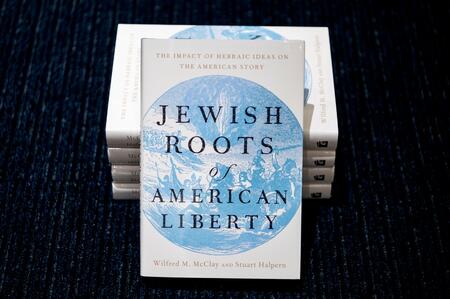
It is under these circumstances in which the Zahava and Moshael J. Straus Center for Torah and Western Thought convened an assortment of scholars, educators and journalists on February 22, 2026, to celebrate the launch of Jewish Roots of America Liberty: The Impact of the Hebraic Ideas on the American Story (Encounter Books). Hosted at the Roosevelt House Public Policy Institute at Hunter College, and sponsored by the National Endowment for the Humanities (NEH), with support from the Academic Engagement Network, the gathering of over 80 Yeshiva university students, staff, alumni and community members explored both the roots of the deep Hebraic foundations of the American story and the branches of the future of that story.
Roots
The first address of the night featured Dr. Ruth Wisse, professor emerita at Harvard University and distinguished senior fellow at the Tikvah Fund, in conversation with Rabbi Dr. Stuart Halpern, deputy director of the Straus Center and the co-editor of Jewish Roots of American Liberty.
Dr. Wisse diagnosed the problem on two fronts. On one end, she noted the depletion of American history departments across the country, creating generations of students who are unfamiliar with the basic facts of their homeland, let alone the Jewish contribution to it. “If these people are not taught their history,” she posed to the audience, “how does the country expect to perpetuate itself?”
But zooming in on Jewish education, Dr. Wisse emphasized that the Jewish community’s focus on the Holocaust as the primary narrative of modern Jewish history was a drastic mistake. “We are telling the wrong story,” she lamented. “The triumph of antisemitism and the failure of Jewish political strategy.”
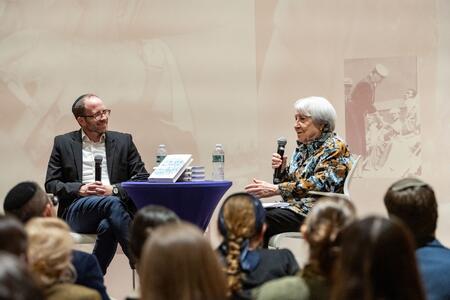
Instead, Dr. Wisse argued that Jewish education should turn their attention to the establishment of the State of Israel and its many triumphs over its short existence. “Is there anything comparable in Jewish history? Is there anything comparable in human history, in the history of nations?” Dr. Wisse asked, referring to the creation of the state just a few years after the decimation of European Jewry. By truly understanding the history of Israel’s founding, Dr. Wisse argued, American Jews would gain the intellectual and moral confidence to tell their story, both the Israeli and American aspects.
“It is not a miracle that we are here after millennia,” Dr. Wisse noted. “This is not an accident of history. We are here after millennia primarily because of the history that we carry within ourselves.”
Branches
The event then shifted to a panel discussion with Ilana Kurshan, author of If All the Seas Were Ink and Children of the Book, and Rabbi Dr. Ari Lamm, co-founder and president of SoulShop Studios, moderated by the Wall Street Journal’s Elliot Kaufman. Together, the three discussed remedies to Dr. Wisse’s diagnosis and how to restore the American story.
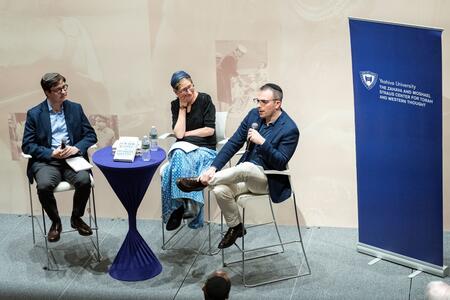
Ms. Kurshan began the conversation by offering the Jewish textual tradition as a potential solution, one that offers both “close reading and also very far-ranging interpretations.” This method, Ms. Kurshan noted, which is used when studying everything from the Bible to the Talmud and the respective commentaries, allows readers to fill in the gaps where the text is wanting or unclear while, at the same time, being sensitive to past interpretations.
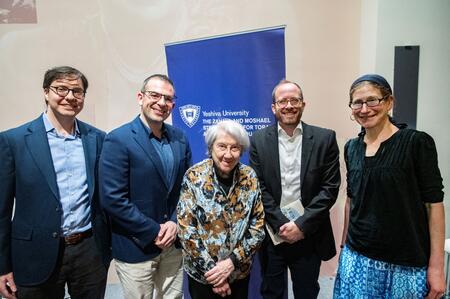
Ms. Kurshan also highlighted the cyclical nature in which Jews read the text, referring to the year-long biblical cycle and the seventy-and-a-half-year Talmudic cycle, which allows for both constant interpretation and textual familiarity. “Every time the text is different because we are changed,” she said. Like water, “the Torah takes a different shape every time we encounter it. Every time we return to the text, we are going to see something different.”
Sharing some of his research on the American Christian community, Rabbi Dr. Lamm also pushed for a reliance on Jewish text as a way to share the Jewish story. He noted that young Christians today do not view Israel as a beacon of the West, partially because Israel does not appear in their social media feeds as much as antisemites such as Nick Fuentes or Tucker Carlson would have us believe, and partially because they do not “buy the argument.” However, Rabbi Dr. Lamm pleaded that this educational gap could be filled if Israel “leveraged its best and arguably only natural resource: the Bible.”
By speaking to Christians with a text they are familiar with, Rabbi Dr. Lamm argued, we can invert the conversation. “Stop asking what their questions are about Israel,” he appealed, “and ask what their big questions are. Israel is the answer to those questions.”
Click here to learn more about Jewish Roots of America Liberty: The Impact of the Hebraic Ideas on the American Story.
Subscribe to the Straus Center newsletter to stay up to date on the latest Straus Center events, publications and news. Click here to sign up.
To learn more about the Straus Center, click here. And be sure to like the Straus Center on Facebook, follow us on Twitter and Instagram, and connect with us on LinkedIn.