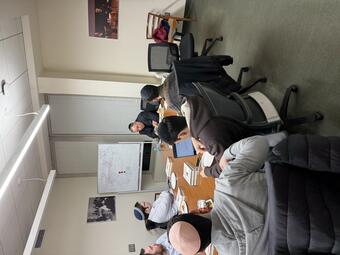
On February 10, 2026, the Zahava and Moshael J. Straus Center for Torah and Western Thought, in conjunction with the Jay and Jeanie Schottenstein Honors Program, hosted Douglas Century to discuss his National Jewish Book Award finalist Crash of the Heavens: The Remarkable Story of Hannah Senesh and the Only Military Mission to Rescue Europe's Jews During World War II. The conversation was moderated by Straus Center Senior Scholar Dr. Tevi Troy.
Century began the discussion by giving a basic overview of Hannah Senesh's heroic life. Senesh dreamed of becoming a poet and a teacher. While she succeeded in the former, she found herself writing her poems on British military bases while training as a paratrooper instead of in the classroom. Just five years after fleeing the Nazi threat, she parachuted back into occupied Europe in an effort to help the British war effort and save her fellow Jews from extermination. And while she was captured before succeeding in her mission, her bravery and resilience earned her the title of the “Jewish Joan of Arc” and turned her into a modern hero in the newly founded State of Israel.
Century dispelled some of the inaccuracies of Senesh’s story, most notably that she was captured immediately after parachuting into occupied territory. In reality, Senesh conducted numerous military missions between March and June 1944 in occupied Yugoslavia before crossing over to Hungary, where she was captured after being betrayed by double-agents.
Century stressed that two oft-repeated claims about the famous parachutists’ mission are simply not historically accurate: that “no Jews were saved” during the operation and that “not a single Nazi was harmed.”
Century relayed the well-documented story of Matilda Glattstein, a pregnant Slovakian Jewish prisoner whom Hannah Senesh personally helped escape from Gestapo captivity in Budapest, and his recent interview with Dr. Baruch Glattstein, Matilda’s son, a retired Israeli police inspector and forensics expert in Jerusalem who is only alive today because “Hannah Senesh saved my mother.” The author also discussed the post-war testimony in the United States Holocaust Memorial Museum archives given by Reuven Dafni, one of Senesh’s fellow paratroopers, in which Dafni described the many Nazi soldiers he killed and the German trains they successfully sabotaged in Yugoslavia as partisan fighters.
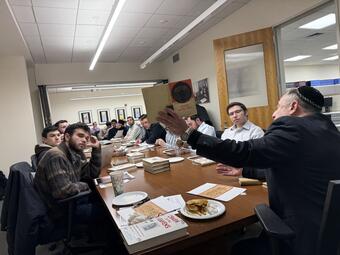
Century reviewed comparisons between Senesh and Anne Frank. Century noted that Senesh provided a narrative of heroism for Jews around the world. “Hannah was a woman warrior who believed that Jewish dignity stemmed from Jewish strength," he said. This was especially important, as Anne Frank’s narrative of victimhood became the dominant story of the Holocaust for some time, and having an alternative was important to the Jewish psyche.
Toward the end of the discussion, Century took some questions from the audience, including two in Yiddish–a language Century learned at a Jewish Day School in Canada–touching on Senesh’s poetry, the impact of her mission and the future of her story.
Subscribe to the Straus Center newsletter to stay up to date on the latest Straus Center events, publications and news. Click here to sign up.
To learn more about the Straus Center, click here. And be sure to like the Straus Center on Facebook, follow us on Twitter and Instagram, and connect with us on LinkedIn.