By Dave DeFusco
Finding a place to live is one of the first challenges many newcomers face when arriving in the United States. For international students, skilled workers and other recent arrivals, renting an apartment can be surprisingly difficult even when they have stable income, savings or job offers.
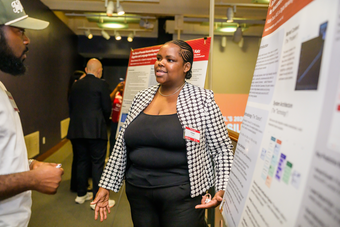
At the 2026 Symposium on Science, Technology and Health, Fildah Tsuro, a student in the Katz School’s M.S. in Digital Marketing and Media, presented a new approach to housing access, “Redefining Rental Access: A New Standard for Housing Equity for Newcomers in New Jersey.”
The research examines how the traditional rental system often excludes people who do not yet have a U.S. credit history. While landlords commonly rely on credit scores to evaluate potential tenants, newcomers frequently arrive without the financial records needed to pass those checks.
“Many highly qualified newcomers are financially stable and ready to contribute to the economy, but they are denied housing because they lack a U.S. credit score,” said Tsuro. “The current system treats the absence of credit history as a risk, even when there is strong evidence that a person is reliable and capable of paying rent.”
As a result, many newcomers turn to what Tsuro calls “shadow markets”—informal rental arrangements that often involve sub-landlords, unofficial agreements and little legal protection. These situations can lead to higher costs, housing instability and increased exposure to scams and fraud.
To address the problem, Tsuro designed a Multi-Factor Reliability Index that assesses renters based on verified academic, professional and financial information rather than primarily on U.S. credit history.
“The goal is to measure reliability, not just credit history,” said Tsuro. “A person’s ability to pay rent can be demonstrated in many ways, including academic enrollment, employment contracts, financial resources and verified international banking relationships.”
At the center of the system is a secure digital verification process that creates what Tsuro calls a reliability passport. The passport would allow landlords to review verified information about prospective tenants without relying solely on traditional credit reports.
The process begins with identity verification using biometric and passport-based authentication. Financial information would then be securely validated through existing technology platforms that can confirm banking activity and international credit histories. Once verified, the information would be compiled into a tamper-resistant certificate delivered directly to landlords.
“By creating a direct verification pipeline, we can eliminate many of the costly intermediaries that currently stand between landlords and renters,” said Tsuro. “That reduces opportunities for fraud while making the rental process faster and more transparent.”
The research focuses particularly on New Jersey, which Tsuro describes as a critical housing hub for people working in the New York metropolitan area. Counties such as Hudson, Essex and Morris have become major destinations for international students, professionals and other newcomers seeking access to jobs and educational opportunities.
Tsuro said New Jersey’s growing foreign-born population is increasing demand for rental housing while exposing weaknesses in systems that depend heavily on domestic credit histories. As international migration continues to grow, the gap between housing demand and housing access is expected to widen.
Tsuro’s model uses secondary datasets and predictive analysis to estimate how alternative verification methods could affect housing outcomes. The findings suggest that newcomers who are evaluated using broader data sources may present lower default risks than some domestic renters who have limited credit records. The model also indicates that reducing reliance on unverified intermediaries could significantly decrease rental scams.
Most important, the research suggests that separating “reliability” from domestic credit history could reduce housing disparities by as much as 50%.
“This is ultimately about equity and opportunity,” said Tsuro. “New Jersey and New York depend on global talent. We need systems that recognize people’s qualifications and financial responsibility, regardless of where they come from. A fairer housing system benefits newcomers, landlords and the broader economy.”