On May 3, 2026, Yeshiva University hosted Antisemitism in the United States Today: Current Social Science Research, a landmark, all‑day conference that brought together some of the nation’s most influential scholars to confront contemporary antisemitism through a social science lens. Co‑sponsored by YU’s Wurzweiler School of Social Work and the Ferkauf Graduate School of Psychology, the conference set a new standard in the effort to tackle antisemitism, directly addressing urgent challenges such as online bigotry and bias on college campuses.
The event convened an extraordinary cross‑section of experts from psychology, political science, human development, education, technology and social work to define and measure antisemitism. Topics explored were its psychological and social mechanisms, the accelerating rise of online hate, the complexities of the campus environment and the role of professional and graduate training in driving change. With more than 250 in‑person and virtual attendees, the conference drew a deeply engaged audience of social workers, psychologists, academic faculty, student life administrators and higher education leaders from across various fields.
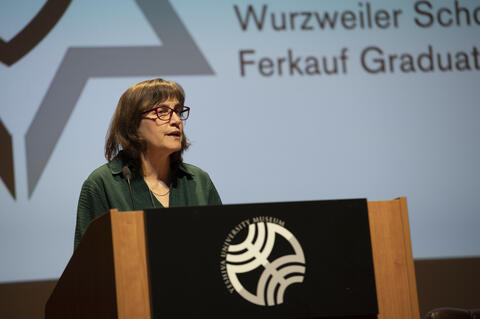
Opening remarks were delivered by Dr. Leslie F. Halpern, dean of the Ferkauf Graduate School of Psychology, and Dr. Randy Magen, the Dorothy & David Schachne Dean of the Wurzweiler School of Social Work, who framed the day as a critical moment for scholarship with real‑world consequences. Also addressing the conference was Dr. Selma Botman, Provost and Senior Vice President for Academic Affairs at Yeshiva University.
“For much of my life, like for many Jews in the United States, I didn’t have to consider antisemitism, I lived a privileged existence, that’s my lived experience,” Dr. Magen told the attendees. “But lived experience alone isn’t enough. That’s why we brought together researchers and scholars on antisemitism, to share the best available social science research on antisemitism. Yeshiva University is the flagship Jewish University in the United States. We have a duty to advance knowledge about issues important to the Jewish people.”
Notable presenters included keynote speaker Dr. James Loeffler, the Felix Posen Professor in Modern Jewish History and director of the Leonard and Helen R. Stulman Jewish Studies Program at Johns Hopkins University; Dr. Gunther Jikeli, a leading global authority on contemporary antisemitism; Dr. Tara E. Liberman, founder and director of the Jewish Community Mental Health Initiative (JCMHI); Dr. Graham Wright, an expert in quantitative research and survey methodology; Dr. Laura Shaw Frank, an internationally recognized scholar of Jewish life and higher education; Dr. Jeff Sherman, a social psychologist and expert in stereotypes and prejudice; and Dr. Todd Pittinsky, a renowned researcher of AI-driven discrimination in online spaces, with a focus on antisemitism. They were joined by other respected researchers across the social sciences dedicated to scholarship on antisemitism.
“With the alarming increase in antisemitism worldwide, we felt it was imperative to convene this conference to bring together an interdisciplinary group of scholars, researchers and experts to share their findings with the community and with each other,” said Dr. Halpern. “We also heard from individuals working in their communities to confront antisemitism at the individual, group and educational levels, to learn more about mechanisms to help reduce its harmful effects.”
At a moment when antisemitism is becoming more widespread and more normalized in American culture, in digital spaces and on college campuses, the conference underscored the urgent need for comprehensive research that will lead to significant change and impactful solutions. The conference served as a historic act of leadership by the University, transforming scholarship into strategies that create urgently needed and lasting change in the fight against antisemitism.