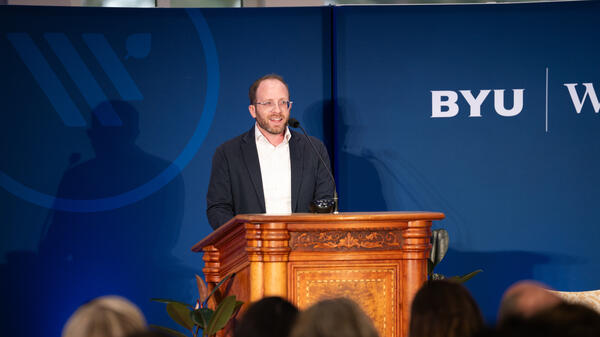
At a recent event hosted by the Wheatley Institute at Brigham Young University, Rabbi Dr. Stuart Halpern, Deputy Director of the Straus Center for Torah and Western Thought, delivered a lecture titled "The Hebrew Bible's Ancient Avengers: How Hebraic Heroes Shaped the American Story." The lecture examined the enduring influence of biblical figures as the American superheroes of today. Following his presentation, Rabbi Dr. Halpern participated in a thoughtful question-and-answer session that explored themes of covenant, citizenship, faith, and hope in contemporary America.
Building on the ideas developed in his lecture, Rabbi Dr. Halpern was asked about the significance of covenant, a concept central to both Jewish and Mormon traditions, and how it relates to American citizenship. Drawing on George Washington's 1790 letter to the Hebrew Congregation of Newport, Rhode Island, he reflected on the responsibilities that accompany participation in a democratic society.
According to Rabbi Dr. Halpern, citizenship is not defined by adherence to a particular religious doctrine. Rather, it is demonstrated through a commitment to contributing positively to one's community and country. He noted that Washington viewed America as a nation blessed with a unique purpose, one whose success would depend on a sense of shared mission and responsibility among its citizens. Healthy civic life, Rabbi Halpern suggested, requires individuals to see themselves as participants in a larger project and to work toward the common good.
To illustrate this point, he cited the late British Chief Rabbi Lord Jonathan Sacks, who often remarked that “non-Jews respect Jews who respect Judaism.” Rabbi Dr. Halpern suggested that this insight extends beyond Judaism. People of faith can best contribute to society not by downplaying their convictions but by living them authentically, demonstrating purpose, integrity, and commitment in their daily lives. Such examples, he argued, have the power to enrich civic culture and strengthen communities.
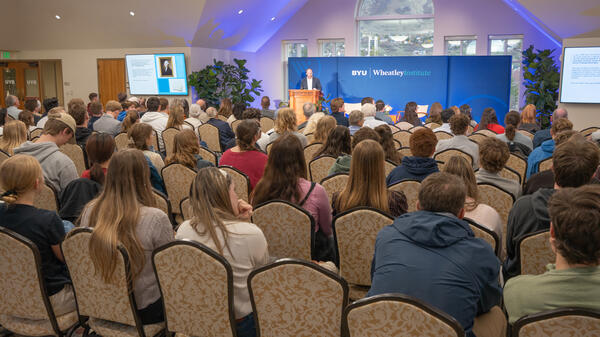
Throughout the discussion, Rabbi Dr. Halpern returned to a theme that had animated his lecture: the importance of preserving a sense of mission and moral direction. While acknowledging the very real failures and injustices that have marked American history, he cautioned against allowing those failings to eclipse the nation's aspirations. A mature understanding of America, he argued, recognizes both its shortcomings and its ideals. The country's covenantal vision, rooted in biblical concepts of responsibility and purpose, remains an important source of national renewal.
The conversation concluded with a more personal question: in a world marked by conflict, polarization, and uncertainty, what gives him hope, as a person of faith?
Rabbi Dr. Halpern pointed to one of America's most iconic symbols, the Liberty Bell. Inscribed with a verse from the Hebrew Bible, the bell reflects the profound influence of biblical ideas on the American story. Yet it is also famously cracked and imperfect. Invoking Leonard Cohen's observation that “there is a crack in everything, that's how the light gets in,” Rabbi Dr. Halpern suggested that the Liberty Bell's brokenness mirrors the American experience itself. The nation is imperfect and unfinished, but its ideals continue to inspire people across generations.
He shared a particularly moving memory from a recent trip to Philadelphia with students from the Straus Center for Torah and Western Thought. While at the Liberty Bell, he observed a group of Israelis with special medical needs who had traveled to the United States. Watching them in their wheelchairs before a national monument engraved with words from the Hebrew Bible, he was struck by the powerful connection between their ancient heritage and the American experiment. “Can you imagine,” he asked “what they must have felt seeing how a verse that they know in Hebrew from the Jewish Bible has stood since before America was an independent state, inspiring all those to come together to visit this site under the concept of freedom and liberty as they understand it.” The moment served as a reminder of how enduring principles can unite people across cultures, backgrounds, and experiences.
For attendees, the event offered far more than a historical discussion. Rabbi Dr. Halpern's lecture and the subsequent conversation highlighted the continued relevance of biblical ideas in shaping civic life and public responsibility. More importantly, they offered a hopeful vision of citizenship rooted in purpose, service, and faith. By encouraging individuals to contribute to their communities while remaining committed to higher ideals, Rabbi Dr. Halpern challenged his audience to view citizenship not simply as a legal status, but as a shared covenant and a call to help advance society toward its highest aspirations.