
Researchers, clinicians, engineers, industry leaders and students from around the world gathered at the Yeshiva University Museum from Oct. 19 to 21 for the IEEE International Conference on E-health Networking, Application & Services (HealthCom 2026), hosted by Yeshiva University’s Katz College of Science and Health. A leading forum for health and health care technology for more than two decades, HealthCom drew more than 400 submissions from around the globe and more than 200 participants for three days of research presentations, workshops and discussion.
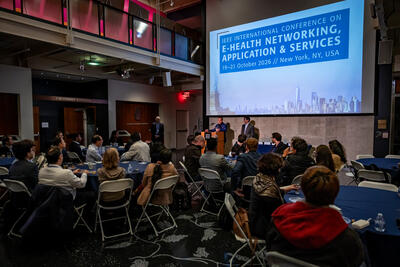
Dr. Honggang Wang, founding chair of the Department of Graduate Computer Science and Engineering and an IEEE Fellow, served as general co-chair with Dr. Paul Russo, vice provost of Yeshiva University, dean of Katz College and an IEEE senior member. Dr. Shucheng Yu, associate chair of the department and director of the M.S. in Data Analytics and Visualization, served as technical program co-chair.
Each day opened with keynote talks exploring how AI, wireless sensing and wearable data are reshaping health care. Dr. Jiebo Luo of the University of Rochester traced AI for medicine from deep learning to large multimodal models. Dr. Yingying (Jennifer) Chen of Rutgers University showed how wireless signals can track breathing, heart rate and even eating without wearable sensors. Dr. Wei Ding of the University of Massachusetts Boston presented work on fair, intelligent health assessment from wearable data, and Dr. Giuseppe Polese of the University of Salerno discussed how multimodal and privacy-preserving AI can make clinical assessment more objective. Wang, Yu and Dr. Marian Gidea, associate dean of Katz College, chaired the keynote sessions.
An “AI for Health” panel brought together experts in clinical AI, biomedical informatics, mobile health, the Internet of Things and wireless networking: Dr. Rui Zhang of the University of Minnesota, Dr. Nada Philip of Kingston University, Dr. Andrea Sciarrone of the University of Genoa, Dr. Benyuan Liu of the University of Massachusetts Lowell and Dr. Hsi-Pin Ma of National Tsing Hua University.
Katz College researchers also presented their work. Dr. Wang; Dr. Hua Julia Fang, professor and director of the M.S. in Artificial Intelligence; Ph.D. student Dengyi Liu; and Ph.D. studentt Xin Xiang developed an interpretable AI model that forecasts diabetes onset from sparse patient records, and Dr. Wang and Dr. Fang co-authored a framework for explainable melanoma detection. Ph.D. student Ashikur Nobel and Abigail Liu presented a low-cost, privacy-preserving way to model human pose from Wi-Fi signals. Dr. Yucheng Xie, assistant professor of graduate computer science and engineering, co-authored RoViSense, a humanoid-assisted radar system for monitoring vital signs, with Wang and M.S. in Artificial Intelligence student Lei Zhang. Dr. Youshan Zhang and M.S. in AI graduate Jialu Li presented work on federated learning for veterinary heart imaging and on AI-generated medical images.
Katz College researchers also led sessions throughout the program. Dr. Xie chaired a technical session and two workshops, including one on cybersecurity for mobile health, and Dr. Ming Ma, assistant professor of graduate computer science and engineering, chaired a session and co-chaired a workshop on trustworthy medical AI. Dr. Joseph Panzarella, clinical assistant professor and director of the M.S. in Digital Marketing and Media, managed the peer-reviewed technical sessions.
The conference’s Young Researcher Symposium gave the next generation a platform to present early work and receive feedback, with projects mentored by Dr. Fang, Dr. Yu, and Ph.D. students Ahikur Nobel and David Li.
HealthCom is the latest in a series of IEEE conferences hosted by Katz College, following the IEEE 4th International Conference on Digital Data Processing in 2024, with Wang as general chair, and the 10th annual IEEE/ACM Conference on Connected Health: Applications, Systems, and Engineering Technologies (CHASE) in 2025, the largest in the conference’s history, with Russo as general chair.
“Hosting IEEE HealthCom 2026 reflects Katz College’s commitment to research, interdisciplinary education and global collaboration,” said Dr. Wang. “By connecting expertise across AI, computer science, cybersecurity, data analytics and health sciences, Katz creates opportunities for faculty and students to turn innovative ideas into meaningful impact.”


