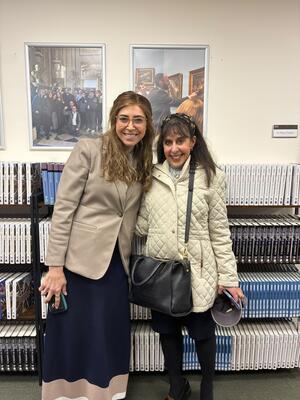
On October 12th, the Straus Center for Torah and Western Thought’s Lunch ‘n Learn series welcomed Professor Roberta Kwall, a law professor at DePaul University whose work explores Jewish law, American Jewish identity, and creativity. The session focused on her book Polarized: Why American Jews Are Divided, and What to Do About It. Resident Scholar Dr. Shaina Trapedo introduced Kwall, guided the discussion, and invited questions from the audience.
Co-sponsored by the Jay and Jeanie Schottenstein Honors Program, the program began with Kwall describing a broader American trend: political disagreement is increasingly treated not as a difference of opinion, but as evidence that the other side is immoral. She connected this “sectarian” polarization to a censorious climate in academia and to what she calls a “political-religious stew,” in which political and religious beliefs become intertwined. In her view, this dynamic amplifies extreme voices and makes people in the middle less willing to speak.
She argued that American Jewish polarization has a distinctive shape. Kwall characterized roughly 75% of American Jews as both politically liberal and religiously liberal—using “religiously liberal” to mean non-Orthodox—and described the remaining 25% as including many politically conservative Jews, among them many Orthodox Jews and some Sephardic and Mizrahi communities. Because Jews may reason from different religious and moral frameworks, she urged people to learn the “language” of other Jewish traditions and to understand the values behind them. Drawing on social psychologist Jonathan Haidt, she highlighted three moral frameworks: autonomy, divinity, and community.
Kwall used abortion debates to show how religious frameworks can shape views on secular issues. She discussed scholar Elli Fischer’s distinction between a broad, “wholesale” position and case-specific, “retail” judgments in Jewish law in his article "Feticide in Halakhah: Attitudes, Approaches, and Application,” written for The Oxford Handbook of Jewish Law. She also contrasted the Orthodox Union’s nuanced response to Dobbs with Agudath Israel’s emphasis on federalism. Her point was that Jewish positions are often more complex than political slogans suggest.
Kwall identified Israel as a major—and, particularly since October 7, increasingly sharp—source of division among American Jews. She argued that Jewish communities need spaces for disagreement while maintaining a shared commitment to Jewish identity and Israel. She also called for more social contact and mutual understanding between Orthodox and non-Orthodox communities, and for greater attention to Jewish learning, practice, and faith.
Kwall then presented eight points as a possible foundation for a common Jewish communal narrative that the majority of American Jews can agree upon:
- Israel has the right to exist as a Jewish democratic state.
- Americans were shocked and unprepared for the severity of anti-Jewish and anti-Israel sentiment after October 7.
- American universities have largely disappointed in their efforts to fight campus antisemitism.
- Antisemitism should be opposed from all sources, including the political right, the left, and intersectional and gendered forms.
- Hamas, all forms of Islamic terrorism, and terrorism by extremist Jewish Israelis should be explicitly condemned.
- Innocent Palestinians who are also victims of radical Islamic ideology deserve Jewish sympathy and support.
- Criticism of Israeli governments, policies, and decisions is appropriate.
- A two-state solution is an aspirational ideal for a long-term resolution of the Israeli-Palestinian conflict.
In the question-and-answer session, students challenged whether Israel-centered principles could alienate younger Jews or people who do not share them. Kwall replied that a shared narrative should also emphasize meaningful Jewish education and practice, stronger Jewish norms, and engagement with difficult questions. Her overall message was that understanding across differences—and building a durable Jewish identity for future generations—requires both openness to debate and a clear communal foundation.