
For Israeli archaeologist Dr. Yosef Spiezer, the past is not confined to books or buried deep in the ground. It is visible in the landscape: in fragments of pottery scattered in the dust, the remains of an ancient wall, an olive press carved into bedrock or a ritual bath tucked into a hillside.
Learning to recognize those traces can transform an ordinary walk through Israel into a journey across thousands of years.
“The land actually talks to you,” Spiezer said. “It wants to say something.”
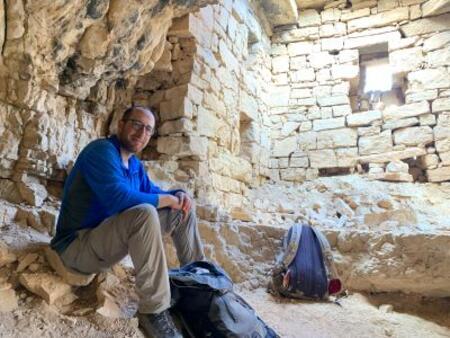
Spiezer has spent much of his life learning how to listen. His family’s roots in Jerusalem stretch back seven generations, and for several years during his childhood, he lived in Sataf, in the Jerusalem Hills, surrounded by ancient agricultural terraces and springs. Long before he studied the landscape as an archaeologist, he knew it as his own backyard.
Now, as a Fulbright Postdoctoral Fellow and Visiting Research Scholar, he is bringing his perspective and scholarship to Yeshiva University’s Center for Israel Studies, where he will spend the 2026–27 academic year working with Dr. Steven Fine, the center’s director. Spiezer is the first Fulbright Scholar in Jewish Studies to come to YU.
Earning a prestigious Fulbright means making it through an academic gauntlet. The Fulbright Israel Postdoctoral Fellowship program, part of the larger international Fulbright Program, awarded just 16 fellowships across all academic disciplines for the 2026–27 academic year.
For Spiezer, who earned his Ph.D. at Bar-Ilan University in 2025, that meant roughly six months of scrutiny. His research proposal, dissertation and publications underwent evaluation, followed by an intensive interview before a panel of experts. After being awarded the fellowship, he had considerable freedom to choose where in the United States he would pursue his research. He chose Yeshiva University.
A major draw was Fine, a prominent cultural historian and scholar of Jewish antiquity whose expertise will offer Spiezer a broader perspective on the findings that emerge from his research.
Spiezer’s Fulbright project will build on his doctoral studies at Bar-Ilan University, where he examined Jerusalem’s rural hinterland during the Hasmonean, Roman and Byzantine periods. That work raised a question now central to his research at YU: What was life like for ordinary Jews in rural Judea before the Maccabean Revolt?
The story of the Maccabees, celebrated each year during Hanukkah, has become emblematic of Jewish resilience. But while the story of the revolt is familiar, the everyday lives of the people who preceded it remain far less understood. Archaeological evidence is scattered across excavation reports, and the dating of some discoveries remains uncertain. Spiezer hopes to develop a clearer picture by reassessing excavation and survey findings and by using digital mapping technology (GIS) to identify patterns across the landscape.
Focusing on rural Judea from the late fourth to the mid-second century BCE, a period stretching from the conquests of Alexander the Great to the emergence of the Hasmonean state, Spiezer will explore the lives of its inhabitants, particularly in the years preceding the revolt: how they organized agricultural production, the objects they used in their homes, how they practiced Judaism and the ways their communities connected to Jerusalem.
“The rebels came from communities with histories, livelihoods and relationships of their own,” Spiezer said. “Those communities deserve to be studied before they enter the narrative of revolt.”
Piecing together this largely untold history is part of the appeal.
“Research requires both the impulse to ask a question and the patience to work toward an answer,” he said.
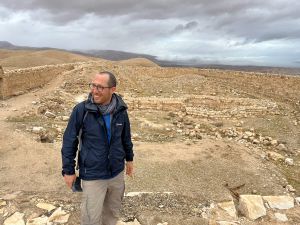
Spiezer will share his methodology, data and findings with Fine, testing his interpretations as the research progresses and making sure he is standing on “stable ground” before drawing conclusions.
His collaboration with Fine is only part of the story. Spiezer is equally eager to exchange ideas with colleagues and students.
“What I particularly value is the opportunity to share work before the conclusions are fixed,” he said. “A good question from a colleague can make you return to familiar evidence and see something you had overlooked.”
Those conversations will take place in reading groups organized by Fine and Dr. Jill Katz, a YU professor of archaeology, bringing together the Center’s Charney Fellows, faculty, doctoral students and scholars from the region. Spiezer is also planning a lecture at the Bernard Revel Graduate School of Jewish Studies and looks forward to sharing the history and archaeology behind Hanukkah with audiences beyond Yeshiva University.
Above all, Spiezer hopes to bring the landscapes and archaeological discoveries of Israel into closer conversation with the Jewish learning that is central to YU and its wider community. “My aim is to bring archaeology and textual study together, to allow each to enrich the other,” he said.
And the learning, he hopes, will go both ways. “I came here to research and lecture, but also to learn. Living within an American Jewish community, rather than encountering it only during a short visit, is already an important part of that education.”


