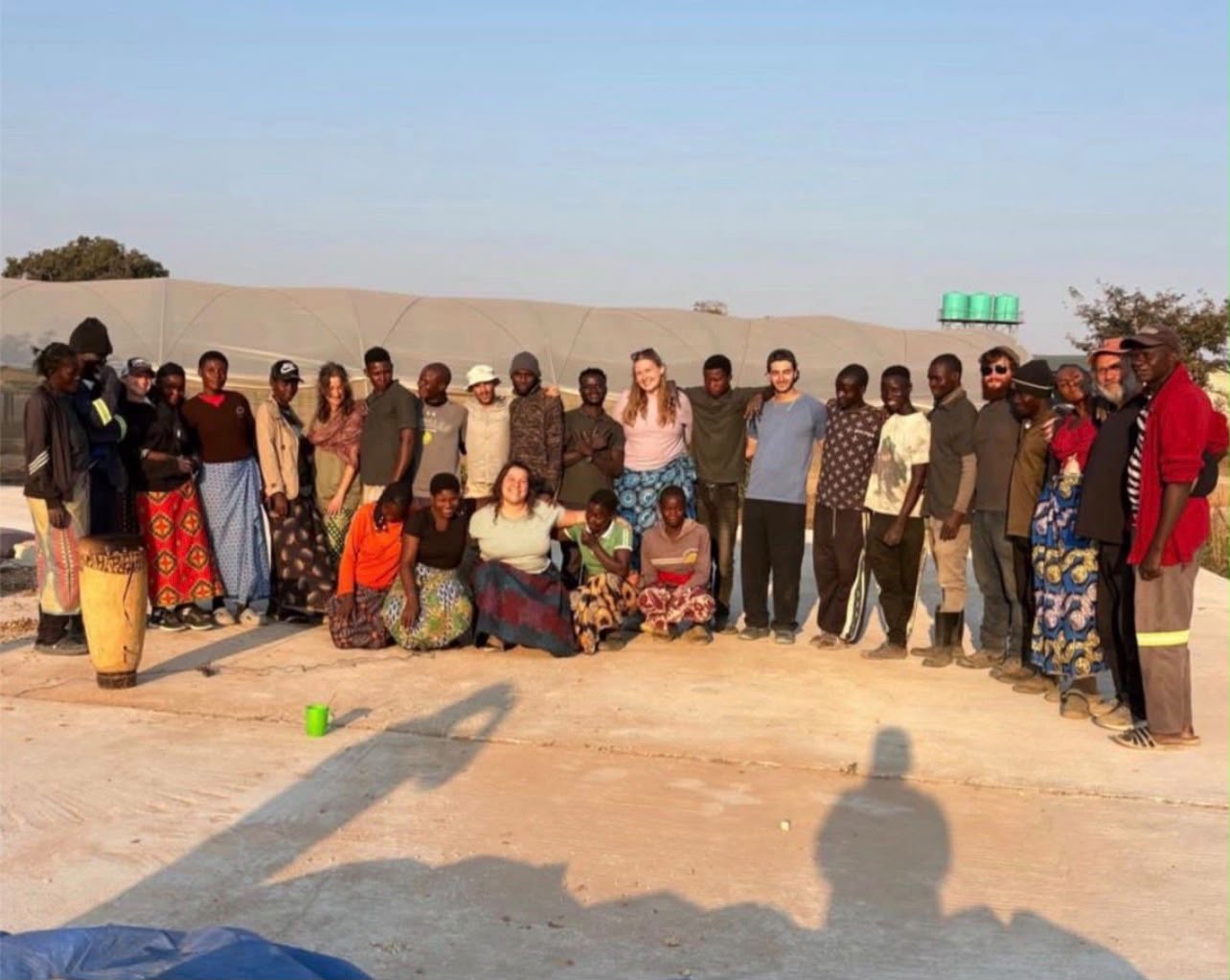
Chloe Baker (SCW '26) reflects on her experience in Tevel b’Tzedek’s Service Learning Cohort in Zambia.
What were the main tasks you undertook during your internship or fellowship?
During my time as a participant in Tevel b’Tzedek’s Service Learning Cohort in rural Zambia, my work fell into two main components of agriculture and teaching. Each day included three hours of agricultural labor, which varied widely depending on the farm’s needs. This ranged from harvesting tomatoes and onions to prepping old land for a new planting cycle, tending seedlings in the greenhouse, and clearing failed crops. For example, when our entire cauliflower crop became diseased, I helped pull and dispose of it. I also spent significant time shelling ground nuts, one of the more meditative, repetitive tasks that gave me time to reflect on the broader purpose of the work and extra time to bond with my Zambian counterparts.
The teaching component was the other core piece of my program. I taught 4-5 classes a week to two groups—Tevel’s Youth Service Program (YSP) participants, and a small group of farmhands. My curriculum spanned informal English education and career readiness, including cover letter writing, CV refinement, and job application strategy. Preparing these lessons required research, drafting, trial runs with peer feedback, and revision before I taught the finalized material. Beyond the classroom, I took part in seminars on international development, ethical volunteering, and the NGO sector, as well as shiurim examining social justice through a Torah lens.
What were your research areas or key work objectives?
One question shaped my summer more than any other. On one of our first nights as a group in Nanduba village, on Tevel’s Roneet Carmell Training Farm, we lost power and decided it was a good night for a bonfire. Sitting around it, we talked about Tevel, its work, and our goals for the summer, and the conversation kept circling back to one question: in the age of globalization, what happens to the poorest people in the world? It was a fascinating discussion about modernization, technology, and how the world keeps getting more advanced and, at the same time, smaller, and about how it is up to us to make sure no one gets left behind. Being on the ground in rural Zambia, somewhere more underdeveloped than anywhere I had ever been before, let me see firsthand what that question actually looks like in practice: what can and does happen to people left out of that progress, but also what becomes possible through farming, empowerment, and education, and through people simply believing in the power of others.
First was being useful to the farm in whatever way the agricultural work required. Our tasks shifted constantly because we had to adapt to what was actually needed on the ground rather than what we’d planned. Second was passing along our knowledge and experience to the YSP participants in a way that genuinely empowered them. Our cohort split across four educational focus areas: English, Financial Literacy, Building and Construction, and Sexual Health. Within that, I led English and career readiness.
Alongside that teaching, we also spent a heavy share of our time supporting the agronomists and farmhands directly in the fields, and one of the questions I kept coming back to through that work was how farming actually uplifts communities out of poverty. Watching and practicing alongside the farmhands and agronomists, I came to understand farming as fundamentally providing two things at once: food for a family, and income generation. These two things done together is what makes it such a powerful tool against poverty.
Two other focus areas ran alongside the day-to-day work. One was social justice through a Jewish, Torah-based lens. We had shiurim on this and learned about Tevel b’Tzedek’s own founding from that same motivation. The other was the history and political landscape of Zambia itself; we happened to be there during a presidential election cycle, and in our first days a local Zambian professor gave us a lecture on the political context and what voters were looking for in a president. Given my background in international relations and Israel advocacy, I was especially drawn to the diplomatic relationship between Israel and Zambia. Early in the program, we met with Israel’s ambassador to Zambia, Ofra Farhi, alongside a delegation of Zambians who had just returned from a trip to Israel, and discussed the newly opened embassy and the ties between the two countries in agriculture, education, and beyond. On my days off, I made a point of visiting two museums so I could understand more of the country’s history and political landscape on my own.
Which skills did you improve or develop during this experience?
First and foremost, I developed my skills as a teacher. As a recent graduate still figuring out which direction I want my life and career to go in, and someone with a real passion for education, this summer gave me hands-on experience as an informal educator and a much clearer sense of where my strengths lie and what I still need to work on.
I also became more adaptable and flexible. Plans changed constantly on the ground, and I had to get comfortable adjusting what I’d prepared to match what was actually needed rather than what I’d expected. Alongside that, I sharpened my patience and listening skills. Many people I worked with spoke English as a second or third language, so real communication required slowing down and listening carefully, rather than communicating at a pace I am used to. Additionally, I sharpened my skills as a student. So much of what I encountered was unfamiliar to me at first, and I found that staying curious and open-hearted was what let me absorb it.
Being in an unfamiliar environment, surrounded largely by Israelis and Zambians rather than Americans, also tested and ultimately grew my confidence in my ability to connect with others. I’ve always considered that a strength of mine, but seeing it hold up in a place completely foreign to me, and being able to still laugh and connect with people across real differences in language and life circumstance showed me that it’s something I can rely on wherever I am. I also grew as a public speaker. I love talking with people one-on-one, but standing in front of a group to teach or present has always made me a little nervous, and this summer gave me repeated practice at it.
Describe one or two significant discoveries or accomplishments. Were there tasks that surprised or particularly challenged you?
One moment from teaching particularly left an impression on me. During an advanced English group lesson on synonyms, I used the word “enthusiastic” almost by accident, just speaking casually. None of them had heard it before, and they loved it. We went over what it meant, how to use it, and how to say it. I figured that was that.
A few days later, in career development class, the group wrote practice cover letters. One student asked me to read just her closing line out loud. I did, and her face lit up while the class clapped and laughed. It read: “I would be enthusiastic if my application is considered.”
That moment provided a humble, yet immensely valuable lesson. To me, “enthusiastic” is just a word I use all the time without thinking. To them, it was brand new and exciting. And the reverse was true for me constantly—things that were completely ordinary to the farmhands, the way they worked the land, the way they greeted each other, the way they sang so beautifully, were new and amazing to me. It was a constant exchange, both ways, the whole time.
As the Lubavitcher Rebbe says, “if you know alef, teach alef.” Whatever you know has value to give over. We’re each finite people, but what we can build together when we're curious, willing to learn, and willing to love, feels infinite.
The other discovery was smaller in the moment but has stayed with me just as much: the power of a simple smile and a “mwauka bwanji” — good morning in Nyanja, the local language. We arrived on the farm knowing no one, and within a short time each of us felt genuinely connected to the people there. Language and difference of circumstance didn’t have to dictate who I connected with or how—that connection was available through the simple, repeated act of acknowledging someone’s presence. I tried to live that out in small ways, like going to eat lunch with the farmhands or walking staff members home after work instead of just heading back with my own group. It sounds almost too simple to call a ‘significant discovery’, but learning how much distance a smile and consistent presence can close, across a real language and life-experience gap, is one of the things I’m most proud of from this summer.
Why do you believe this work is important, and why should other Straus Scholars consider pursuing similar research or internships?
I believe every person should spend time (ideally volunteering) in a developing country at least once in their life. It gives you a perspective on the world you can’t obtain any other way. Coming back, you’re more grateful, and not in a cliche way just for material things, but for your education, your opportunities, and the circumstances you were born into. It’s humbling in that sense. You also come back simply knowing that an entirely different way of life exists and is being lived, fully, by people who are not so different from you.
I believe this work matters because helping people is close to the essence of humanity. In Tehillim we're told “olam chesed yibaneh”—the world will be built with lovingkindness. The Gemara in Gittin 61a goes further, teaching that we provide sustenance for the poor among non-Jews alongside the poor among Jews, visit the sick among non-Jews alongside the sick among Jews, and bury the dead among non-Jews alongside the dead among Jews—mipnei darkei shalom, for the sake of peace. And Pirkei Avot 3:14 opens with “chaviv adam shenivra b'tzelem,” "beloved is the human being, for they were created in the Image." The Mishnah deliberately says Adam, human being, not Yisrael, showing that humanity in general is beloved first, before it goes on to speak of Israel’s particular belovedness. Besides for my own personal desire to do this work, the Torah provides a supportive and encouraging framework that serves as a foundation for my intentions. These sources further prove that the person you're helping has inherent dignity simply because they are a human being created b’tzelem Elokim.
As Jewish people, I believe we have both the opportunity and the responsibility to be an ohr l'goyim, a light unto the nations, and there’s no shortage of Torah sources calling on us to care for the broader world, not only for our own community. I’d encourage anyone considering this kind of work to pursue it. You learn an enormous amount, build relationships you couldn’t have predicted, and come home with a genuinely new perspective. As someone hoping to build a career in the field of international development, this summer was both personally and professionally eye-opening. However, I don’t think that field is a necessary prerequisite for this. Our volunteer cohort was made up of people with very different interests, and I think anyone, regardless of what they’re passionate about, has something real to learn from an experience like this one.