The 2026 Constitution Day Lecture at the Pepperdine School of Public Policy featured Rabbi Dr. Stuart Halpern, the Deputy Director of the Straus Center for Torah and Western Thought, who explored the enduring influence of the biblical Queen Esther on the American political imagination. The program was introduced by Abbylin Sellers, the Edward L. Gaylord Professor of Public Policy at Pepperdine. Dr. Sellers teaches welfare policy, great books, and the foundations of American constitutionalism, emphasizing the importance of moral and ethical principles in shaping effective public policy.
In this address, Dr. Halpern examined how the story of Esther has resonated throughout American history. As he detailed, Esther’s example of courage, sacrifice, and leadership has inspired Americans across the political spectrum, from the founding era and the American Revolution to the Civil Rights Movement and contemporary political debates. Her story, he argued, has repeatedly served as a moral framework through which Americans have understood questions of liberty, responsibility, and public leadership.
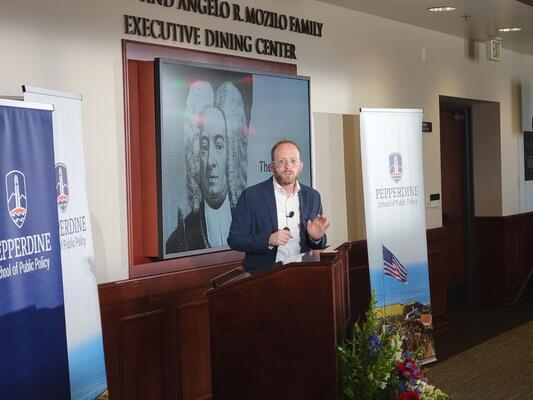
During the question-and-answer session, participants explored the continuing relevance of Esther in modern political discourse. One audience member asked about comments made by the Michigan Attorney General, who had invoked Esther while arguing that Jews should be willing to sacrifice their own interests for a perceived greater good. Rabbi Halpern noted that Esther continues to function as a powerful political symbol and rhetorical touchstone, even if the story was misinterpreted in this instance.
Another attendee asked about popular stories concerning Benjamin Franklin and James Madison and the role of Hebrew in early America. Rabbi Halpern used the question to discuss the deep Hebraic roots of American education and culture. He noted that institutions such as Harvard and Yale once required Hebrew study, and that commencement addresses were delivered in Hebrew. Familiarity with the Hebrew Bible, he explained, was once considered an essential component of a classical education and was woven into America’s cultural foundation. He also recounted how, in July 1776, Franklin and Thomas Jefferson proposed a design for the Great Seal of the United States depicting Moses raising his arms as Pharaoh’s army drowned in the Red Sea. Although the proposal was ultimately rejected, Halpern argued that it reflected the profound influence of biblical narratives on the American founding.
Questions also turned to contemporary issues, including relations between Israel and Iran. Referencing the Book of Esther’s Persian setting, one audience member asked how we can once again restore the relationship. Rabbi Halpern distinguished between the Iranian people and the Iranian regime, emphasizing that many Israelis and Persians harbor no hostility toward one another. He illustrated this optimism with a humorous Purim anecdote from the previous year, when a celebrant dressed as an El Al airline representative carried a sign advertising a fictional “direct flight from Tehran to Tel Aviv,” expressing hope for better days ahead.
Another attendees question sparked a discussion of antisemitism and the significance of teaching America’s Hebraic heritage in the aftermath of October 7, 2023. Rabbi Halpern argued that understanding the Jewish contribution to the American story is more important than ever. He stressed that the relationship between America and Israel is not merely political or strategic, but rooted in shared moral ideals and historical narratives. The Hebraic spirit, he maintained, is deeply embedded within the language of American liberty and democratic values. He concluded by saying that “the inspiration of Jewish heroes and heroines like the ones studied today is something that can hopefully offer comfort to Jews during this harsh moment and continue to offer inspiration for all Americans."