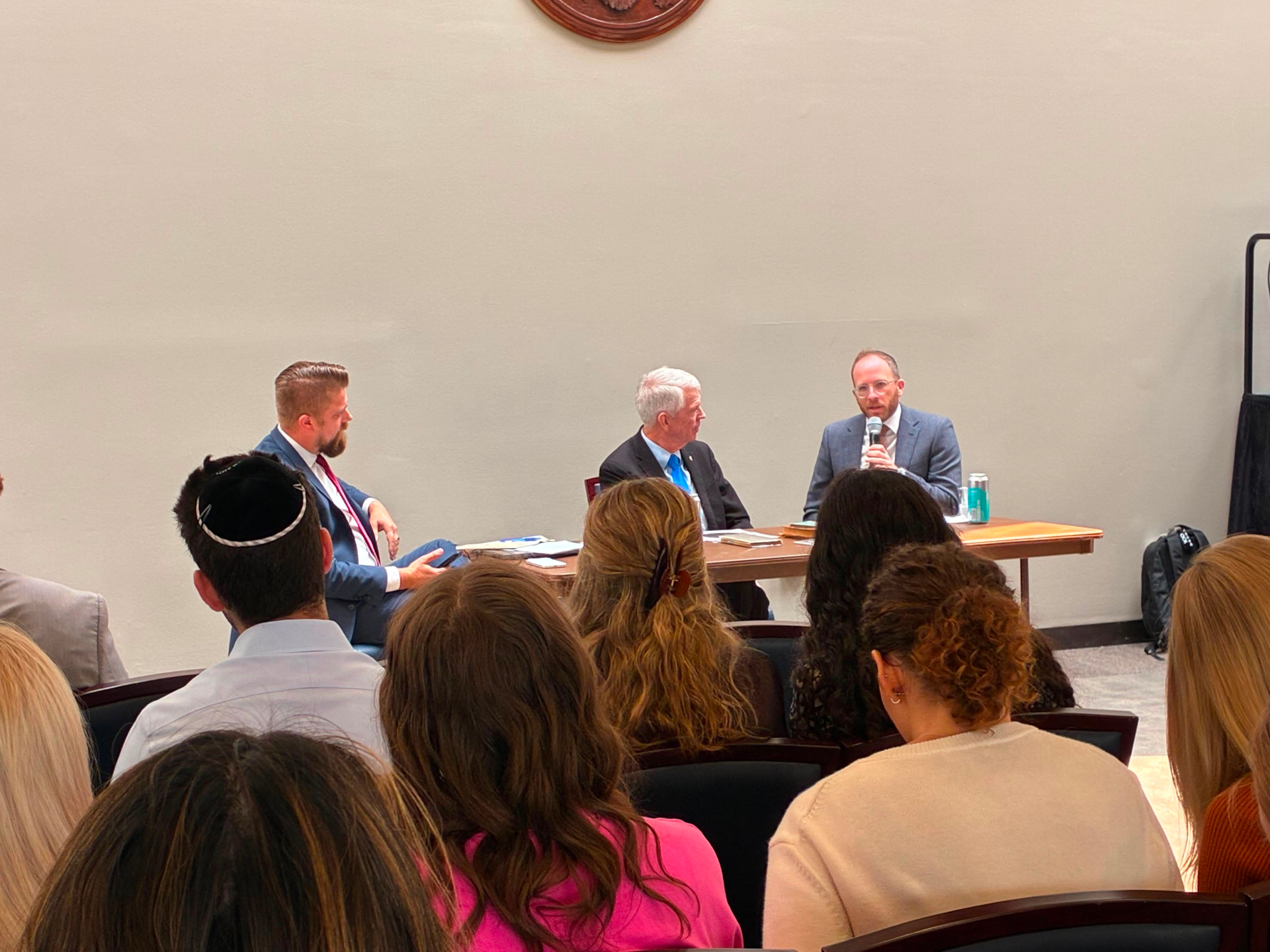
On July 29th, Rabbi Dr. Stuart Halpern, Senior Advisor to the Provost and Deputy Director and Chief Strategy Officer of the Straus Center for Torah and Western Thought at Yeshiva University, presented alongside David Barton of WallBuilders — a historian and founder of the organization known for documenting America's founding through the lens of its biblical and Christian influences — at the Hart Senate Building, at an event sponsored by the Museum of the Bible. The program's goal was to trace 250 years of the Bible's influence on American life, and it drew a packed room.
Barton argued that the Bible was the single most important intellectual and legal foundation for the American experiment. He noted that the United States had endured under the same Constitution for 250 years, and he tied that exceptional longevity to biblical ideas embedded in the founding. Citing a University of Houston study of 15,000 founding-era documents, he highlighted that 34% of quotations came from the Bible — far more than from thinkers like Montesquieu or Blackstone — with Deuteronomy, Psalms, Proverbs, Jeremiah, Chronicles, Judges, John's Gospel, and 1 Peter especially prominent. For him, the tragedy of recent decades was that Americans benefited from a legal and civic order shaped by Scripture while increasingly forgetting its biblical roots.
The heart of the discussion belonged to two biblical texts that had quietly shaped how Americans understood freedom, crisis, and moral duty: the Book of Esther and the Book of Exodus.
Rabbi Dr. Halpern offered a striking argument: the Book of Esther had long served as a lens through which Americans interpreted political danger and personal responsibility. He pointed to the decade before the American Revolution, when colonists were still wrestling with a difficult question: whether resistance to King George III was justified. Many hoped, at first, that the fault lay with his ministers rather than the king himself.
Rabbi Dr. Halpern explained that preachers of the era reached for a familiar biblical parallel to make sense of their moment, describing how the story offered an ancient template for a people oppressed by a scheming minister while a distracted king looked the other way. Hundreds of colonial preachers used the Purim narrative to help their congregations decide whether standing up to a king could be justified. As tensions escalated toward war, the dominant biblical metaphor shifted — from Esther's court intrigue to Exodus's confrontation with tyranny, with George III recast as a Pharaoh-like oppressor rather than a misguided ruler.
That framework, Rabbi Dr. Halpern argued, never really left American political life. He noted that Esther 4:14's call to leadership "for such a time as this" continued to surface across the political spectrum, cited by figures with little else in common. He specifically pointed to Democratic and Republican leaders alike recognizing their own defining moments in Esther's story — proof, in his words, that the text kept giving new meaning to new generations, regardless of party.
He connected this idea directly to the American founding, suggesting that the Exodus story had given the founders a template for imagining their own project: a people freed from tyranny not to wander without direction, but to build a shared life around lasting truths. In his view, this was the deeper logic behind America's approach to religious liberty — not merely keeping government out of belief, but actively protecting the space where communities could live out their convictions.
Jared Kinches (YC '27), a Yeshiva University Lieberman-Mitzner scholar, interning for Rep. Elise Stefanik this summer, reflected on how often Esther had come up throughout his program. He connected the themes of the presentation to a moment last April when fewer than 100 Yeshiva University students traveled to Washington for a policy conference. For Jared, Esther's example — in which Mordechai calls on Esther to advocate for her people — was a challenge to the broader Jewish community. As he put it, they had a responsibility to be in politics firsthand, actively lobbying for their community's interests.
By the event's closing, one message had emerged clearly: the Bible's oldest stories were still doing active work in America's political imagination, offering both a way to interpret the past and a call to responsibility in the present.