By Dave DeFusco
For most people, speaking feels effortless. We take a breath, begin talking and rarely think about the complex coordination happening inside our bodies. But for children with asthma, a condition that affects breathing, producing clear and stable speech may be more challenging than many realize.
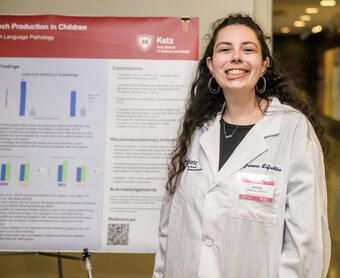
At the 2026 Symposium on Science, Technology and Health, Jemma (Shayna) Lifschitz, a student in the M.S. in Speech-Language Pathology, presented her research, “Asthma’s Relationship to Speech Production in Children.” The study examines how asthma-related breathing difficulties can affect the development and quality of speech in young children.
“Speech production depends on a strong partnership between breathing and voicing,” said Lifschitz. “When a child has asthma, that partnership can be disrupted because they may not have enough breath support to sustain clear, stable speech.”
According to the National Institute on Deafness and Other Communication Disorders, speech is produced during exhalation as air passes through the vocal folds, causing them to open and close rapidly. This process creates sound, which is then shaped by the tongue, lips and mouth into recognizable speech. Because speech relies on a controlled flow of air, healthy respiratory function is essential.
Asthma can interfere with that process. The condition causes inflammation and narrowing of the airways, making it more difficult to move air in and out of the lungs. As a result, children with asthma may struggle to coordinate breathing and voicing, leading to reduced speech clarity, inconsistent vocal quality or difficulty sustaining longer utterances.
“Asthmatic children often have insufficient breath support for speech,” said Lifschitz. “That can affect their ability to coordinate respiration and phonation, which may impact speech stability and intelligibility.”
The topic is particularly important because asthma is one of the most common chronic illnesses in children worldwide. In the United States, approximately 6.5% of children have asthma. While the condition is typically associated with coughing, wheezing and shortness of breath, its potential effects on communication are less widely recognized.
Lifschitz’s research highlights growing evidence that improving breathing control may also support speech development. Studies suggest that teaching children breathing exercises can strengthen the coordinated breathing patterns needed for effective speech production.
“One of the key findings from the literature is that increased control of asthma can improve speech production,” said Lifschitz. “When children learn how to manage their breathing more effectively, they may be better able to support their voice and communicate clearly.”
Among the interventions examined was balloon breathing, an exercise that encourages children to control their exhalation while inflating a balloon. Research has shown that this type of activity can improve respiratory coordination and increase asthma control in young children.
“Balloon breathing is a simple example of how children can practice using their breath more efficiently,” said Lifschitz. “These exercises can help build the respiratory foundation needed for both healthy breathing and effective speech.”
The implications extend beyond communication. Learning efficient breathing patterns early in life may help children reach important speech and language milestones while also supporting overall respiratory health.
“Breath support is essential for voicing,” said Lifschitz. “Focusing on improving overall breath support may encourage young speakers to use their voices in the most optimal way.”
Elisabeth Mlawski, Lifschitz’s advisor and a clinical associate professor in the medical speech-language pathology program, said the research sheds light on an important but often overlooked connection between respiratory health and communication development.
“This work helps us understand that speech does not happen in isolation,” said Mlawski. “The respiratory system provides the foundation for speech production, so when breathing is compromised, communication can be affected as well. Understanding that relationship allows speech-language pathologists, healthcare providers and families to better support children with asthma.”