By Dave DeFusco
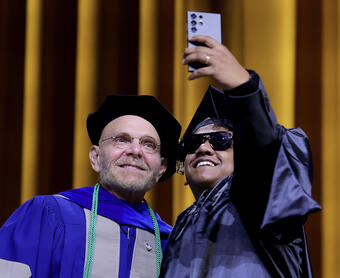
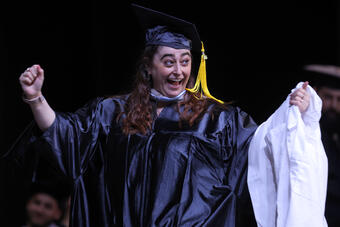
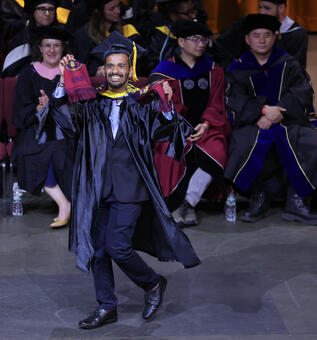
Over 600 graduates marked the culmination of years of hard work and purpose-driven study on May 20 during the Katz School of Science and Health’s ninth annual commencement ceremony at the United Palace, celebrating a milestone that represented not only academic achievement, but personal transformation.
The ceremony reflected the spirit of the Katz School itself: ambitious, diverse and deeply connected to the idea that education should inspire a commitment to lifelong scientific inquiry and service to the community. Graduates represented programs in both science and technology and the health sciences, including the first graduates of the accelerated bachelor's in nursing, and their stories were animated by the wisdom and insights gained through experiences across continents and industries.
Dean Paul Russo praised the graduates for their academic accomplishments and for the impact they have already made through research, clinical care and community service.
“The university continues to chart a future around four pillars: science and health, innovation and entrepreneurship—all in service of producing values-driven leaders who are prepared for great jobs and impactful careers,” he said.
Dean Russo highlighted the extraordinary achievements of students and faculty across the school. Speech-language pathology students provided more than 1,300 therapy sessions through the school’s virtual clinic, and expanded clinical understanding of asthma in children and developed protocols for whispering syndrome. In August, physician assistant students are preparing to travel on a medical mission to Rwanda to work with children with disabilities. Artificial intelligence and computer science students are developing a brain repair platform that uses machine learning to restore function affected by neurological conditions.
“Each of you brings a unique sense of purpose to the Katz School and we are privileged to have you join the ranks of Yeshiva University alumni,” said Dean Russo. “Class of 2026, your accomplishments are impressive.”
The commencement ceremony also reflected the school’s remarkable institutional growth. Michael Katz, son of the school’s benefactors, Drs. Mordecai and Monique Katz, who recently contributed an additional $50 million to transform the school into a comprehensive college, spoke about the significance of the moment and the vision behind the school’s expansion.
“This change reflects not only rapid growth and expanding programs but an ever-deepening commitment to world-class faculty, research and innovation,” said Katz. “The school’s remarkable growth—doubling in size over the past five years to become the largest graduate school at Yeshiva University—is a testament not only to my father’s vision but to the extraordinary leadership of our dean and the dedication of the administration and faculty who bring that vision to life every day.”
Yeshiva University President Ari Berman delivered a heartfelt address centered on the Jewish concept of inner light and personal purpose. “I deeply love the Katz community,” said Berman.
He recalled attending a special Hanukkah celebration with the Katz School community—the first time many students had heard of the holiday—and explained the meaning behind the tradition.
“It’s about the light that God created within you, a light that Jews believe can never be extinguished,” said Berman. “The Katz School helps bring the light out of students and into the world so that everyone benefits from your warmth and your beauty. It is our belief in you that in any moment of darkness, you have the light to illuminate the world around you.”
His remarks resonated with graduates like Jenna Bondy, who earned a degree in medical speech pathology and was introduced during the ceremony as an embodiment of compassionate, patient-centered care. She reflected on the dedication and perseverance shared by the graduating class.
“We didn’t just end up here,” she said. “We came because we found something that mattered to us. A passion. A purpose. Something we cared enough about to work harder than we ever had before.”
Bondy credited faculty members for creating an environment where students felt challenged and supported. “We were supported by professors who didn’t just teach us but made us feel seen,” she said.
Her comments captured a recurring theme throughout the ceremony: the importance of mentorship and human connection in preparing graduates for meaningful careers. Denelsen Dandi, who graduated with a digital marketing and media degree, offered a reflection on the intersection of technology, ethics and human potential in an era increasingly shaped by artificial intelligence.
“Most of us have seen what happens when an AI system reaches for an answer before it fully knows the truth,” said Dandi. “It hallucinates. At first, that sounds like a flaw. Technically, it is. But in a strange way, it also feels familiar.”
Dandi connected the lessons students learned in their respective disciplines to a broader understanding of responsibility and innovation.
“AI taught us to imagine responsibly,” he said. “Cybersecurity taught us to protect what matters. Data analytics and mathematics taught us to turn confusion into clarity. Biotechnology and the health sciences taught us to serve life itself, and digital marketing and media taught us to transform complex data into stories. Now we leave—not as finished products—but as living prototypes of what is possible.”