By Dave DeFusco
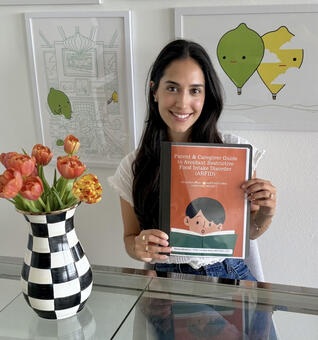
When Vanessa Murad graduates this May from the Katz School’s Occupational Therapy Doctorate, she’ll be giving families something many have been searching for: a lifeline. For parents of children with Avoidant Restrictive Food Intake Disorder (ARFID), her capstone research provides clear, compassionate guidance for a condition that is often misunderstood, isolating and difficult to navigate.
Murad’s “Parent & Caregiver Guide to Avoidant Restrictive Food Intake Disorder (ARFID)” draws on a needs assessment of 33 occupational therapists who work directly with children with ARFID. “I had 100% of participants say that a guide like this is needed and doesn’t exist,” she said. “That was a huge validation.”
ARFID, officially added to the fifth edition of Diagnostic and Statistical Manual of Mental Disorders in 2013, is characterized by restrictive eating that is not driven by concerns over body image. Instead, it typically presents in three ways: sensory sensitivities to different textures or smells, fear of adverse consequences, like choking or vomiting, or lack of interest in eating or food. Its complexity—and the relative lack of research—means many families are left navigating it with limited support.
“I’ve always loved feeding therapy,” she said, “but when I learned about ARFID, I kept choosing it for every research project I could.”
The project also reflects a key collaboration with Anne Sinha, an occupational therapist specializing in ARFID whom Murad met at a national conference. Sinha’s experience helped translate theory into practice.
“There’s not a lot of research—maybe 20 articles that connect occupational therapy and ARFID,” said Murad, “so a lot of what we included comes from clinical trial and error—what’s actually worked with kids.”
At the heart of Murad’s work is the perspective of occupational therapy itself, a discipline uniquely positioned to address feeding challenges. Rather than focusing solely on food intake, occupational therapists analyze the entire mealtime experience: the child’s sensory system, emotional responses, physical positioning and environment.
“We break down big, overwhelming problems into manageable parts,” said Murad. “That’s what helps families move forward.”
Her guide translates that philosophy into actionable strategies. One of the most important, she said, is maintaining neutrality at the table. Caregivers are encouraged to keep a calm voice and neutral expression regardless of whether a meal goes well or poorly. “If you react strongly, children start to associate eating with that reaction,” said Murad. “Neutrality builds trust and reduces pressure.”
Other recommendations focus on creating predictability and safety. Parents are encouraged to consistently include “preferred foods”—items a child feels comfortable eating—while gradually introducing new ones. The approach is gentle and incremental, allowing children to explore unfamiliar foods without fear. For those with sensory challenges, even small adjustments, like adding a crunchy food to help with swallowing or providing a weighted object for focus, can make a meaningful difference.
To ensure her guide resonated, Murad tested it beyond the clinical world. She shared drafts with family members unfamiliar with ARFID, refining the language until it was clear, approachable and reassuring. “It has to be easy to understand,” she said. “You don’t want it to feel overwhelming or scary.”
That emphasis on empathy carries through to her broader outlook. Progress, she said, is rarely linear. Families may see setbacks alongside successes, and patience is essential. “It’s about trusting your child and staying consistent,” she said. “With support, meaningful change is possible.”