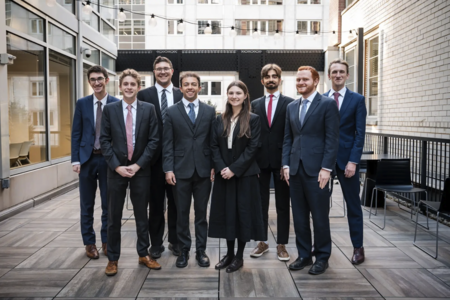
Matthew Minsk (YC ’27), a Straus Scholar and co-president of Yeshiva University’s chapters of the Tikvah Collegiate Forum and the Alexander Hamilton Society, was named a finalist in the inaugural Middle East History Competition (MEHC). Organized by Tikvah and the Alexander Hamilton Society, and hosted in Washington, D.C., the competition brought together top undergraduate students from across the country to demonstrate deep historical knowledge of the Middle East in a live, game-show–style format. MEHC “seeks to foster intellectual excellence in the field of Middle East history, with the hope of encouraging future leaders and experts in the field.” The Impact Office at the Zahava and Moshael J. Straus Center for Torah and Western Thought recently spoke with Matthew about the experience and what he took away from it.

This past fall, Matthew Minsk (YC ’27) traveled to Washington, D.C. as one of eight finalists selected from a national pool of over one hundred undergraduate competitors in the inaugural National Middle East History Competition. The event tested participants on five major works of Middle Eastern history, combining rigorous historical knowledge with live, high-pressure performance.
The competition unfolded in two stages. A preliminary online round challenged students with tightly timed, proctored multiple-choice questions drawn from texts including A History of the Ottoman Empire by Douglas Howard, The Arabs: A History by Eugene Rogan, Israel: A History by Martin Gilbert, Jerusalem: The Biography by Simon Sebag Montefiore and The Middle East: A Brief History of the Last 2,000 Years by Bernard Lewis. From there, eight finalists advanced to the in-person rounds in Washington.
Each finalist fielded questions across all five books, with rounds structured to test both breadth and precision. Matthew finished tied for second place in his group, narrowly missing advancement in a closely contested tiebreaker.
The afternoon semifinal and championship rounds—held before a live audience and moderated by Hudson Institute scholars Zineb Riboa and Mike Doran—were tightly contested. “Three of the five sets in the championship match were decided at the final question, including a decisive 6–5 finish,” Matthew recalled, describing it as “a genuinely exhilarating end.”
Beyond the competition itself, Matthew emphasized the intellectual seriousness of the experience. Preparing for the finals required sustained engagement with a wide historical sweep, from biblical Jerusalem through the Ottoman period and into the modern Middle East.
“The biggest challenge was the material I was least familiar with going in—especially Ottoman history and broader developments in the region outside of Israel,” he explained. “But that was also the most valuable part. That history is critically important for understanding Israel’s geopolitics.”
As a Straus Scholar, Matthew regularly studies the intersection of Jewish and Western political thought, an intellectual background that subtly shaped how he approached the competition. “Straus courses train you to read carefully, think historically, and stay grounded in primary texts,” he noted. “Those habits matter when you’re dealing with dense and complex material.”
Being named a finalist in the competition’s inaugural year, Matthew said, was gratifying in its own right. “It was an opportunity to measure myself against a strong national field and to learn a lot in the process,” he reflected. “Even beyond the results, it was exciting to see how much serious interest there is in Middle Eastern history.”
For Matthew, the study of Israel’s history and foreign policy stuff is “incredibly interesting” but does not define his long-term professional plans. “Nevertheless,” he said, “It was challenging, demanding, and genuinely enjoyable. I’m glad I did it.”
To learn more about the Straus Scholars program, click here.
Subscribe to the Straus Center newsletter to stay up to date on the latest Straus Center events, publications and news. Click here to sign up.
To learn more about the Straus Center, click here. And be sure to like the Straus Center on Facebook, follow us on Twitter and Instagram, and connect with us on LinkedIn.