Douglas Murray has built a career interrogating the ideas that hold civilizations together— and what happens when they fray. A bestselling author, cultural critic, political commentator and journalist whose work spans politics, literature and moral philosophy, Murray will bring that inquiry into the classroom this spring as Yeshiva University’s inaugural President’s Professor of Practice.
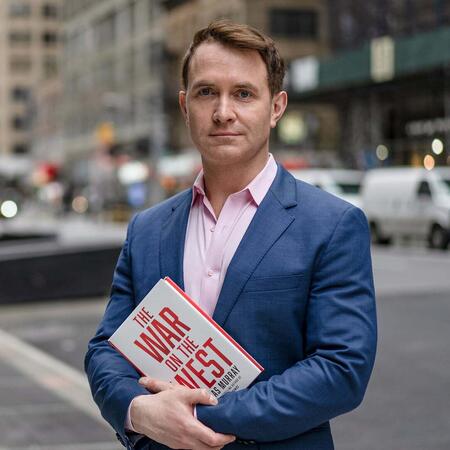
The appointment places Murray, whose recent book On Democracies and Death Cults: Israel and the Future of Civilization examines the clash between democratic values and extremist ideologies, in sustained conversation with undergraduate students. Designed to complement YU’s distinguished faculty, the role brings a leading public intellectual into the academic setting, enriching rigorous scholarship with perspectives shaped by engagement beyond the classroom.
A Professor of Practice appointment recognizes leaders who have shaped public discourse and invites them to contribute that perspective to university life. In that capacity, Murray will deliver a series of lectures within The Values of Verse: Sacred and Secular Perspectives, a Yeshiva College Honors course that explores how poetry has long served not only as aesthetic achievement but as guide to conscience and civilization.
Murray’s writing—which has appeared in The Wall Street Journal, The Times, The Sunday Times, The Spectator and UnHerd—frequently returns to the question of cultural memory: what societies choose to remember, and what they risk losing when foundational texts, ideas and traditions fall away. In recent years, he has written with particular urgency about Israel, free societies and the moral confidence required to defend them.
“Great poetry is not an ornament of civilization,” Murray said. “It is one of the ways civilizations think, remember and endure. In an age of noise and distraction, returning to verse is a way of recovering seriousness—about life, love, loss and responsibility. I’m honored to join Yeshiva University in a setting where those questions are taken seriously and explored with intellectual rigor.”
At YU, Murray will engage students in close readings of poets who wrestled with ultimate questions across centuries—from John Donne and Andrew Marvell to William Blake, the Romantics and modern voices such as W.H. Auden and Seamus Heaney. His lectures will examine how poetry responds to beauty and belief, as well as to rupture, violence and ethical crisis. That approach reflects Yeshiva University’s broader vision for undergraduate education.

“Yeshiva University’s undergraduate programs offer students the opportunity to study with world-renowned experts in their disciplines, including those on our full-time faculty and those in our wider intellectual community,” said Dr. Rebecca Cypess, Dean of the Undergraduate Faculty of Arts and Sciences and Vice Provost for Undergraduate Education. “Douglas Murray will join a generations-long conversation about great works from the Jewish canon and the broader humanistic tradition that is alive and impassioned on our campuses, and we look forward to him sharing his insights and perspectives.”
For students, the appointment offers something increasingly rare in a university setting: sustained engagement with a public intellectual who moves fluently between literature, history and contemporary civic debate. For Yeshiva University, it underscores an educational model that insists the study of texts—sacred and secular alike—remains essential to forming thoughtful, grounded graduates prepared to meet the challenges of the present moment.