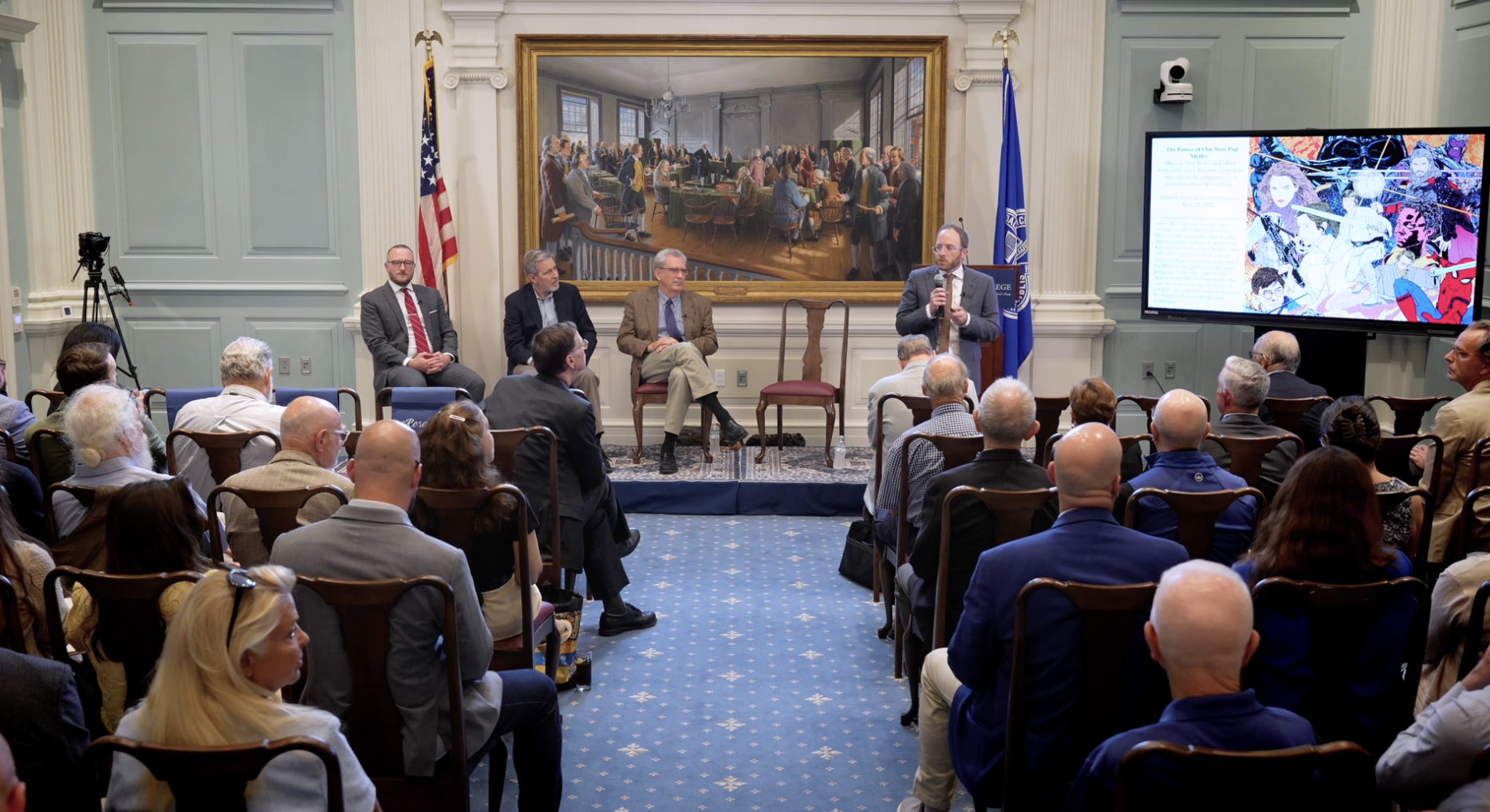
As part of its America 250 celebration, Hillsdale College's Washington, D.C. campus recently welcomed three leading scholars on August 24th for a wide-ranging conversation on how Catholic, Protestant, and Jewish thought each shaped the ideas underlying the American founding. The panel, comprised of historian Bradley J. Birzer, author Mark David Hall, and Rabbi Dr. Stuart Halpern, offered multilayered accounts of how biblical and theological traditions gave the founding generation its vocabulary for liberty, law, and self-government.
Rabbi Dr. Halpern, Senior Advisor to the Provost and Deputy Director of Yeshiva University’s Straus Center for Torah and Western Thought, opened by touching on a 2022 essay by Adam Kirsch in The Wall Street Journal about how modern pop mythology has displaced biblical literacy, and he noted that the Marvel and Star Wars universes have “replaced the Bible as the unifying narrative universe of the United States.” He argued that long before superheroes filled that role, figures from the Hebrew Bible—what he called “the Hebrew Bible’s ancient Avengers”—served as America’s original models for leadership and heroism.
Rabbi Dr. Halpern presented several of these parallels. Moses, he suggested, was something like America's original Captain America: George Washington was eulogized in his own era as "the Moses of Israel," while King George III was routinely cast as a Pharaoh figure. Benjamin Franklin's proposed design for the Great Seal even depicted Moses parting the Red Sea as Pharaoh's army drowned. Abraham Lincoln, too, was likened to Moses by the governor of Illinois, and abolitionists frequently perceived their cause through the lens of Exodus.
Then, shifting to highlight the figure of Esther, Rabbi Dr. Halpern traced how colonists in the years before the Revolution used the Purim story to work through the question of resistance to the crown, framing King George as a well-meaning but misled Ahasuerus and the British Prime Minister as a corrupt Haman. He recounted a striking 1862 episode in which abolitionist minister W.W. Patton and a delegation of clergy invoked the Book of Esther directly in a plea to Lincoln, casting the president as Esther and challenging him with Mordecai’s question of whether he had risen to power “for such a time as this.” Halpern noted that the same phrase continues to surface across the political aisle today, cited by figures as different as Eric Adams and Elise Stefanik—evidence, he argued, that the text still speaks to new generations regardless of party.
Bradley J. Birzer, the Russell Amos Kirk Chair in American Studies at Hillsdale College, turned to a tradition often left out of founding-era narratives. Maryland had been founded as a haven for Catholics, but by 1775 it was, in Birzer’s words, “only 8% Catholic. It was 92% Protestant.” He noted that Maryland’s 1649 Toleration Act was “the greatest act of toleration in the modern world up until the American founding,” permitting anyone to worship as they chose. That changed after the 1689 Glorious Revolution, when a coup by Protestant radicals stripped Maryland Catholics of the right to worship openly, marry legally, vote, testify in court, or hold office—restrictions that held until 1776.
Birzer centered his talk on Charles Carroll, whom he called “the most formally educated of the Founders,” who studied in France before returning to become a prominent voice for independence, despite having no legal standing to hold office as a Catholic. Carroll’s 1773 public debate under the pseudonym “First Citizen” helped move Maryland toward revolution, and he went on to sign the Declaration of Independence alongside Washington and Hancock. Even the staunchly anti-Catholic John Adams held Carroll in high regard, and James Madison later called him "the architect of the Senate" in Federalist 63. Birzer closed by tracing the founding's most famous line—that all men are created equal—back to what he called a rewriting of St. Paul, arguing that ideas like natural law and natural rights were, in his words, "deeply Catholic [ideas] that became Protestantized,” and underscoring how Catholic thought vitally shaped the young republic's founding principles.
Mark David Hall, professor in Regent University’s Robertson School of Government and a Senior Research Fellow at the Center for Religion, Culture & Democracy, pushed back directly against scholarship that treats the Judeo-Christian tradition as marginal to the founding. He cited Daniel Webster's praise of the Puritans as the “authors of American civil and religious liberty,” and Alexis de Tocqueville's own observation that “Puritanism was not only a religious doctrine, but also...mingled with the most absolute democratic and republican theories,” a starting point, Tocqueville said, for his entire study of democracy in America.
Hall argued that the Revolutionary War’s rhetoric and doctrines, such as sola fide (“by faith alone”) and sola scriptura (“by Scripture alone”), flowed directly from Protestant thought and that Protestant New England’s unusually high literacy rates—including a deliberate push for female literacy— combined with congregational church governance to cultivate enduring “habits of self-governance.” He pointed to New England’s vigorous response to England’s 1764-1765 limitation of Parliamentary representation as evidence of those habits already in place before 1776. Hall closed by noting that the founding-era idea of humanity made in the imago Dei, though initially applied narrowly, carried implications that would later fuel the abolitionist movement, reverberating throughout American history.
The Q&A that followed drew the three traditions together. Panelists discussed how liberty, in the Founders’ understanding, was meant to lead law to purpose rather than to mere autonomy. Rabbi Dr. Halpern noted that the actual verse has Moses telling Pharaoh not simply to “let my people go,” but to “let my people go so that they shall worship me...it's liberty leading to law... freedom has to be for a purpose. Otherwise, it's just anarchy.” The group also traced the Founders’ shift from Locke's “life, liberty, and property” to “life, liberty, and the pursuit of happiness,” with Birzer describing Americans as being called to “an uncommon dignity” and Rabbi Dr. Halpern observing that Washington frequently quoted the Book of Micah's vision of peace and fulfillment. Rabbi Dr. Halpern closed the discussion by cautioning against calling America a Christian nation outright, invoking Lincoln's description of Americans as “an almost chosen people,” a nation, in his words, that modeled itself after biblical Israel without ever claiming to replace it.