Over the course of the academic year and summer, Straus Scholars are encouraged to pursue a wide range of research and editorial projects. Straus Scholar Elisha Price (YC ’28) spent the Fall 2025 semester as a research assistant to Dr. Tevi Troy, senior scholar and Impact Office director at the Zahava and Moshael J. Straus Center for Torah and Western Thought. He gained hands-on experience in historical research, political analysis and the production of scholarly and public-facing writing.
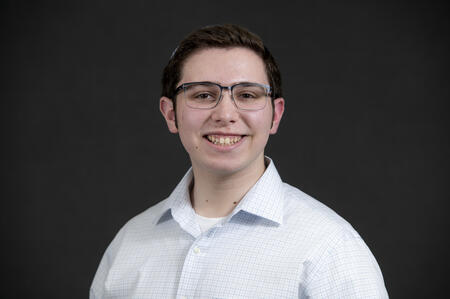
Working alongside Dr. Tevi Troy has been, in Elisha Price’s words, “an immersive masterclass in the mechanics of historical biography and political analysis.” As a research assistant, he moved from the raw data of archives to the polished prose of national publications, helping Dr. Troy prepare for his upcoming work and regular commentary. The Impact Office at the Straus Center sat down with Elisha to hear about his experience.
What were the main tasks?
My primary responsibility was building the foundation for Dr. Troy’s writing. I compiled exhaustive research files—essentially deep-dive dossiers—on specific historical events and contemporary political figures. This involved synthesizing primary sources, archival records and news accounts into organized briefs, with a particular focus on anecdotal material. Once Dr. Troy transformed that research into articles or chapters, I served as the final line of defense, fact-checking his drafts to ensure every date, quote and historical nuance was airtight before publication.
What were your key research areas?
The core of my work centered on the premise of Dr. Troy’s most recent idea for an upcoming book, which remains under wraps. It involved careful historical research. In addition to this historical work, I focused on contemporary governance, specifically researching Mayor Eric Adams regarding the circumstances surrounding his potential exit from office. I also explored the broader relationship between presidents and technology, tracking whether different administrations throughout history acted as catalysts for innovation or as hindrances to technological progress. Other, smaller projects included researching the history of the Psalms in times of distress, the Dutch identities and foreign policy towards the Netherlands of the three Dutch-American presidents (Martin Van Buren and the two Roosevelts), and the political activities of CEOs in the past two years.
Which skills did you develop?
My archival literacy improved immensely. I learned how to sift through vast amounts of information to find the “signal” in the noise—identifying which private letters or meeting minutes revealed the true nature of a relationship between two presidents, and determining what rhetoric is actually reflective of political intent. Furthermore, fact-checking sharpened my attention to detail. When you are working for a scholar of Dr. Troy’s caliber, you learn that historical and journalistic credibility is built on the smallest details; I learned to verify every claim against multiple primary sources.
What was a significant discovery or challenge?
One of the most rewarding challenges was the “archival detective work” required to reconstruct key correspondences between pivotal American figures.
Navigating vast digital archives is a hurdle, but uncovering a specific, vivid anecdote that illustrates a personal rivalry—and then seeing that detail serve as the “color” for one of Dr. Troy's published articles—is incredibly satisfying. It proved that even the smallest archival find can change the texture of a historical narrative.
How did your experience as a Straus Scholar influence your work?
My research was a direct extension of the Straus Center’s commitment to high-level intellectual engagement. Because Dr. Troy serves as a Senior Fellow at the Center, I had the unique advantage of working at the intersection of academic theory and professional historical research. The Straus program’s emphasis on the moral character and ideas of leaders provided the essential framework for my work; it pushed me to see presidents not as sterile policy-making machines, but as human beings navigating all the complexities of life. The Center’s active encouragement of this kind of rigorous scholarship helped me to treat archival records as more than just data—they became a case study in how the personal character of our leaders shapes the very trajectory of American public life.
Why is this work important for other Straus Scholars?
I encourage other Straus Scholars to pursue similar roles because it teaches you that history is a dialogue. It isn't just a series of isolated terms; it is a continuous, often messy conversation between those who have held power. Learning to track those threads is essential for anyone interested in the reality of American political life.
To learn more about the Straus Scholars program, click here.
Subscribe to the Straus Center newsletter to stay up to date on the latest Straus Center events, publications and news. Click here to sign up.
To learn more about the Straus Center, click here. And be sure to like the Straus Center on Facebook, follow us on Twitter and Instagram and connect with us on LinkedIn.