Over Yeshiva University’s 2026 winter break, the Zahava and Moshael J. Straus Center for Torah and Western Thought led a trip for its Straus Scholars to Amsterdam, the Netherlands, where they examined the city’s historical and current Jewish community through the prism of Torah and Western thought.
The trip began with a series of table-setting seminars that introduced the students to Amsterdam’s Jewish history and culture. Straus Center Clinical Assistant Professor Rabbi Dr. Dov Lerner opened the day with “Morteira and Amsterdam’s New Messianism,” where he framed the experience of early Jewish life in Amsterdam through the prism of the unprecedented inclusivity of golden-age Dutch identity, and looked to the design of the Esnoga (Portuguese Synagogue) and sermons of leading rabbis as evidence of the messianic energy it unleashed among both the Jewish and broader community.
This was followed by Straus Center Resident Scholar Dr. Shaina Trapedo’s “Faith, Philosophy, and the Arts in the Ramchal's Amsterdam,” which explored the work of Rabbi Moshe Chaim Luzzatto (Ramchal), the 18th-century Italian Jewish prodigy who revolutionized Jewish philosophy during his Amsterdam years at a time when the city's exceptional tolerance and hospitality toward Jews fostered conditions for unprecedented publication and creative expression. Focusing on his dramatic allegory titled La-Yesharim Tehillah (Praise for Righteousness, 1743), which features figures like Yosher (Rectitude), Tehillah (Praise), and Emet (Truth), Dr. Trapedo illuminated the Ramchal's fusion of poetic invention and philosophical wisdom.
After a lunch break, Straus Center Deputy Director Rabbi Dr. Stuart Halpern discussed “Reuben, Redemption and the Return of England’s Jews: Menasseh Ben Israel’s Hebraic Indian Theory,” which tracked the rabbi’s search for the Ten Lost Tribes among the Native American population in the New World, among his many other endeavors. Finally, Dr. Tevi Troy closed the day of learning with “The Dutch American Presidents,” tracking the relationship between America’s greatest leaders and the Netherlands.
Following the seminars, the Straus Scholars were treated to a canal tour of the city, learning about its history, architecture, and culture through the lens of its famous watery passageways. The first day then concluded with a delicious dinner at Meat Me with divrei torah from students.
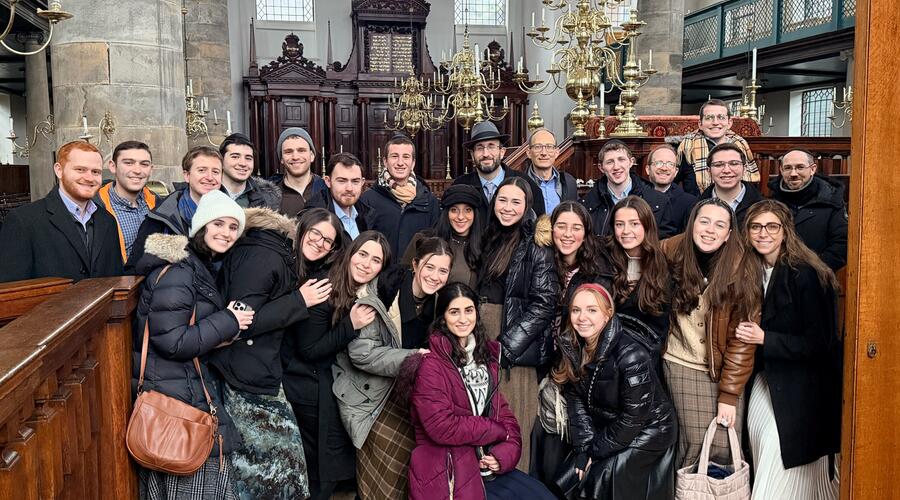
The second day of the trip took the students into the Jewish quarter of the city, where they visited the Rembrandt House Museum and the Portuguese Synagogue. Straus Center Director Rabbi Dr. Meir Soloveichik led the tours of both locations, explaining how each was a testament of the Dutch Golden Age Rabbi Dr. Lerner discussed in his opening lecture. The former served as the headquarters of the artist Rembrandt van Rijn, who ingrained himself in the Jewish community to create some of the most masterful depictions of biblical scenes ever created. The latter, of course, was the central hub of Amsterdam’s Sephardic population, and is still used today on certain occasions.
Rabbi Soloveichik then led his final tour of the day: the Rijksmuseum. There, the students viewed Rembrandt’s The Nightwatch, The Jewish Bride, The Sampling Officials and Jeremiah, as well as Vermeer’s The Love Letter and The Milkmaid.
“The Rijksmuseum was one of the most beautiful museums I have ever stepped foot in,” remarked Gabriel Perla (YC '28). “Being able to stand in front of Rembrandt’s painting of Jeremiah while Rabbi Soloveichik gave his unique analysis was a singular experience. Our short time there left me so moved that I chose to spend the free afternoon before my flight returning to the museum.”
The second day concluded with a dinner with local Amsterdam university students, where the Straus Scholars were able to meet their international peers and discuss politics, culture, and their shared Jewish tradition, despite living an ocean away, followed by a community-wide lecture led by Rabbi Soloveichik.
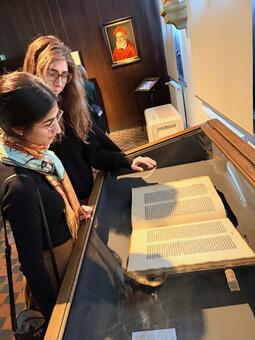
The third day of the trip took the Straus Scholars to Belgium, exploring the Museum Plantin-Moretus and its collection of Bibles (including the Wenceslas Bible and the second Bible ever printed) in Antwerp and the Grand-Place in Belgium.
“At Plantin-Moretus, I really enjoyed walking through the family home and printing workshops,” said Rebecca Guzman (SCW ‘26). “Seeing how books were made hundreds of years ago was especially touching and made me appreciate the way we now have access to knowledge at our fingertips. Their collection of Bibles and old manuscripts was incredible as well.”
The final day of the trip saw the Scholars visit the Mauritshuis in The Hague. While the crown jewel of the museum is Vermeer’s Girl with a Pearl Earing, Rabbi Soloveichik had the students focus on Rembrandt’s Saul and David, which Rabbi Soloveitchik argued beautifully and poignantly captures the relationship between the two biblical figures, and The Anatomy Lesson of Dr Nicolaes Tulp.
To learn more about the Straus Scholars program, click here.
Subscribe to the Straus Center newsletter to stay up to date on the latest Straus Center events, publications and news. Click here to sign up.
To learn more about the Straus Center, click here. And be sure to like the Straus Center on Facebook, follow us on Twitter and Instagram, and connect with us on LinkedIn.