From June 1 to June 4, 2026, the Zahava and Moshael J. Straus Center for Torah and Western Thought joined Operation Benjamin, the American Battle Monuments Commission, and Operation Levi, an initiative of the German War Graves Commission, for a historic trip to Verdun, France, honoring American and German Jewish soldiers killed during the Meuse-Argonne Offensive of World War I. For over 108 years, seventeen Jewish soldiers—five Americans and twelve Germans—lay beneath Latin crosses at the Meuse-Argonne American Cemetery and the Consenvoye German Military Cemetery, their religious identities lost to clerical errors and the chaos of war.
The mission brought together Straus Center Director Rabbi Dr. Meir Soloveichik, Straus Scholars, students from the University of the Bundeswehr Munich, and cadets from Virginia Military Institute, with the purpose of restoring those obscured identities, replacing each soldier’s headstone with a Star of David.
The delegation also included Operation Benjamin President Emeritus Rabbi Dr. Jacob J. Schacter, U.S. Ambassador to France the Honorable Charles Kushner, historian and former Israeli Ambassador to the United States Dr. Michael Oren, and Phillipps-Universität Marburg professor of intellectual history Dr. Ulrich Sieg.
Monday, June 1: Arrival in Verdun
The mission opened with a reception and welcome dinner in historic Verdun, France, featuring a keynote address by Rabbi Soloveichik. Rabbi Soloveichik spoke about the power of collective Jewish memory and highlighted the unique ways in which Jewish identity has always been maintained throughout history, regardless of how deeply Jews were able to view themselves as French or German citizens. The first night of the trip set the tone for a mission dedicated to reestablishing dignity and honoring the memory of these fallen soldiers.
Tuesday, June 2: Honoring the American Soldiers
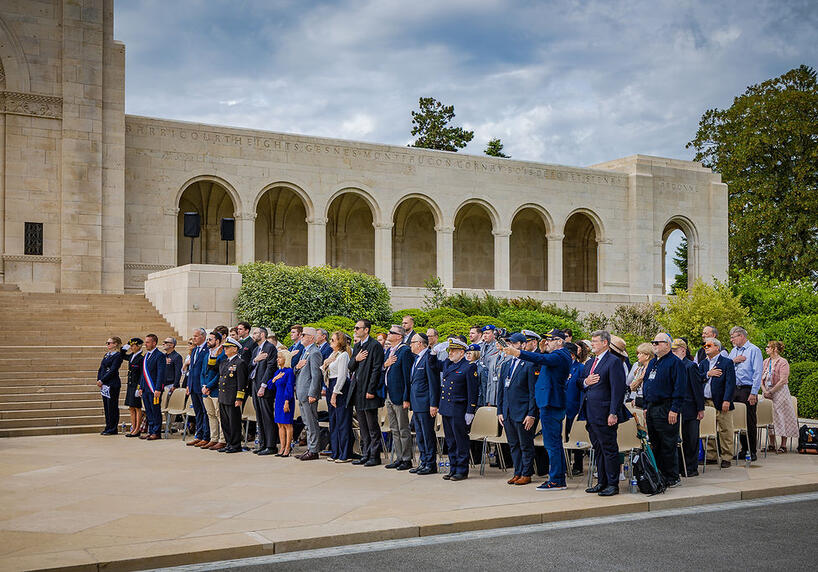
On Tuesday, the delegation traveled to the Meuse-Argonne American Cemetery for headstone replacement ceremonies honoring five U.S. soldiers. Ambassador Kushner offered special remarks at the ceremony, and Dr. Oren delivered a profound speech on the nature of sacrifice and patriotism. Straus Scholars, University of the Bundeswehr Munich students, and Virginia Military Institute cadets heard a lecture from historian Rebecca Dalessandro on the significance and irrevocable impact of World War I.
That evening, the group gathered for dinner and heard from CNN commentator Scott Jennings, who shared his reflections on what it means to dedicate oneself to the pursuit of truth in a fragmented landscape in the wake of October 7th and heightened polarization.
Wednesday, June 3: Honoring the German Soldiers
On Wednesday morning, Dr. Sieg delivered a history lecture ahead of grave marker replacement ceremonies for twelve Jewish soldiers at the Consenvoye German Military Cemetery. German Member of Parliament Dr. Ottilie Klein offered remarks at the ceremony, marking a rare and touching moment of joint American and German commemoration of Jewish servicemen who fought on opposing sides.
Shana Schwartz (SCW ‘26) recalls her participation in the ceremony at the Consenvoye German Military Cemetery, explaining, “I was tasked with the unveiling of a corrected headstone for a German Jewish soldier who fell in battle against the U.S. Army. Standing still for two hours in the cold rain beside his grave as the ceremony proceeded, I reflected upon the significance of my task: to restore an essential part of his identity that had been lost for over a century.”
The delegation then toured the Verdun Ossuary, a memorial containing the remains of both French and German soldiers who died on the Verdun battlefield, the landmark Fort Douaumont, and the ruins of the village of Fleury-devant-Douaumont, before closing the day with a gala dinner featuring a poignant reflection from Rabbi Dr. Jacob J. Schacter.

A Mission of Memory
More than a century after the Meuse-Argonne Offensive, the seventeen soldiers honored on this mission now rest beneath the Star of David rather than a cross that obscured their identities and misrepresented their sacrifice. The work of Operation Benjamin and Operation Levi over these four days did not simply correct a record. It returned something to these soldiers that had been taken from them: the right to be remembered as who they were.
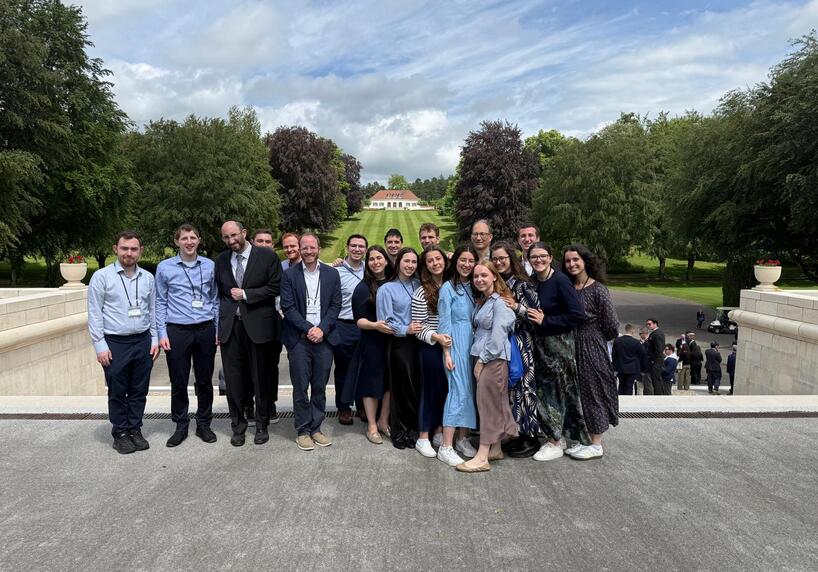
For the Straus Scholars who traveled to Verdun, the mission offered an unparalleled and transformative experience. Says Noam Schechter (YC ‘27), “Being a part of the incredible ceremonies made possible by Operation Benjamin was remarkable. Standing in places where unfathomable numbers of soldiers gave their lives for their countries and families instills a feeling of ultimate sacrifice and commitment. Learning about how the Jewish people were a part of this story provided me with a feeling of purpose and insight into our ancestors.”
Witnessing the grave marker replacement ceremonies with University of the Bundeswehr Munich students and Virginia Military Institute cadets created an extraordinary moment of unity amid a generation that is so often defined by division. Aside from connecting students of diverse backgrounds, the Operation Benjamin mission actualized an aspect of the Straus Center’s ethos by bringing the Straus Scholars into direct encounter with questions of Jewish history and peoplehood. As Rabbi Dr. Soloveichik has long taught, the story of the Jewish people is not contained only within texts, but in chapters of history that may be overlooked for generations. As Rabbi Dr. Schacter observed, Operation Benjamin understands that it is our job as Jews to ensure that our people are honored and that dignity is restored to them—even over one hundred years later.
To learn more about Operation Benjamin's mission to identify and restore the headstones of Jewish American servicemen, click here.
To learn more about the Straus Center for Torah and Western Thought, click here.