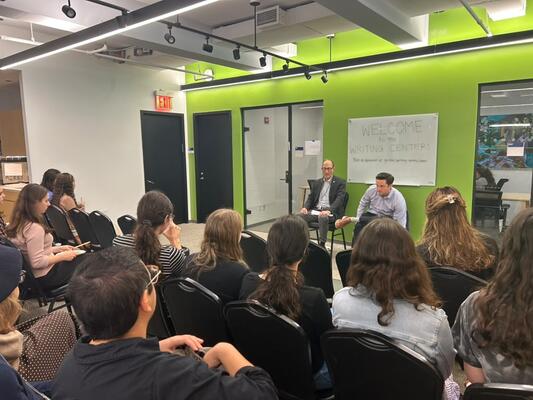
On October 22, 2026, the Zahava and Moshael J. Straus Center for Torah and Western Thought, in partnership with the S. Daniel Abraham Honors Program, welcomed Dr. Shilo Brooks for a lunchtime conversation on how books can change one’s life. Dr. Brooks is the President and CEO of the George W. Bush Presidential Center and Professor of Practice in the Department of Political Science at Southern Methodist University. He previously served as executive director of the James Madison Program in American Ideals and Institutions at Princeton University and has also taught at the University of Virginia and Bowdoin College. A graduate of the Great Books program at St. John’s College, he earned his PhD in political science from Boston College. He is the author of Nietzsche’s Culture War and hosts the Free Press podcast Old School, on which guests discuss the books that changed their lives. The conversation was moderated by Senior Scholar Dr. Tevi Troy, who served as Special Assistant to the President and liaison to the Jewish community (2003-2004) and Deputy Assistant to the President for Domestic Policy (2005-2007) during the Bush administration.
Dr. Brooks opened by describing the premise of his podcast, the goal being not to discuss guests’ favorite books but the ones that left them different after reading. He then turned to his own story: Raised in Lubbock, Texas, in an unstable household, Dr. Brooks was not initially a strong student and did not plan to attend college. Yet he loved reading and turned to literature as a chief passion. As he explained, without mentors to confide in, he figured that books which had endured for thousands of years might hold the guidance he lacked. He eventually applied to St. John’s College, whose curriculum has students read the great books chronologically across literature, mathematics, science, philosophy, and music. A physician from Dr. Brooks’s community offered to cover his tuition on the condition that he uses his education to benefit others. That path led to a PhD at Boston College and then to teaching posts at Bowdoin, Virginia, and Princeton, where a course that began with about 30 students grew to roughly 300 within a year. Dr. Brooks credited his success in the classroom to treating the great books as living works with something to say about real human problems. Plato’s Republic and Shakespeare, he joked, are “self-help books.”
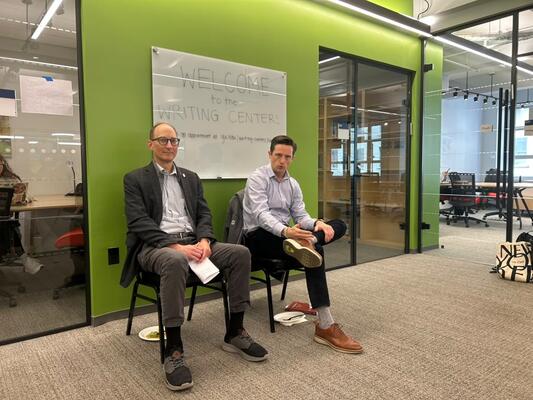
In the Q&A, Stern College Honors students asked Dr. Brooks about his own reading habits. When asked which book changed his life—the central question of his Old School podcast—Dr. Brooks named F. Scott Fitzgerald’s This Side of Paradise. As an 18-year-old in Lubbock, Texas, he said, the novel’s portrait of a young man from the Midwest at Princeton, joining literary societies and debating philosophy and religion late into the night, showed him that other young people shared his questions, and offered the vision of a like-minded community to aspire for.
When asked about his religious background, Dr. Brooks described how he had negatively associated religion with his father in his youth and was initially hostile to it. But at St. John’s, he encountered the depth of the Bible in the context of the Greek philosophic tradition. Reading Leo Strauss on Athens and Jerusalem and Maimonides’s Guide to the Perplexed, which he called the hardest book he has ever read, deepened his interest. His doctoral work on Nietzsche, the West’s most profound critic of religion, he said, nudged him toward appreciating the possible truth of revelation. Today he and his family are part of a religious community, and he described his journey as ongoing.
Responding to a question about how to approach ancient epics like The Iliad, whose characters may seem to lack interior lives, Dr. Brooks pushed back on the premise. Achiles’s rage, he argued, is one anyone who has felt wronged can recognize. He suggested that the true diversity a curriculum can offer lies not only in race and gender, but in time. A warrior on an ancient battlefield may be more foreign to a modern reader than a contemporary author, yet both can speak to enduring, universal human experiences. Books, he said, are an “occasion to live the life of someone else,” whether that is Elizabeth Bennet, Achilles, or Frederick Douglass, whose Narrative he counts among his favorites. He also listed Nietzsche’s Beyond Good and Evil, Xenophon’s The Education of Cyrus, Machiavelli’s The Prince, and Larry McMurty’s Lonesome Dove among the books he returns to the most.
Closing the event, Dr. Brooks explained why he loves teaching The Education of Cyrus and The Prince: the former for its lessons on ambition and youth, and the latter because it makes students “uncomfortable” by challenging them to defend morality against Machiavelli’s case for cunning. Dr. Brooks’s talk ultimately made the case that great books are not merely objects of academic study, but sources of perspective, guidance, and light for anyone willing to engage with complex ideas openly and authentically. His own path, from working at a Texas shopping mall to teaching at Princeton and leading the George W. Bush Presidential Center, is a testament to what a life shaped by reading can accomplish.