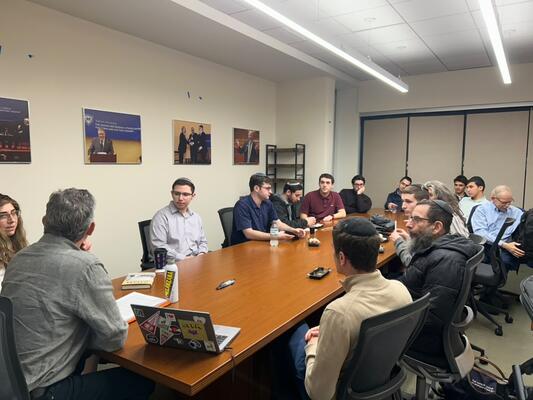
On October 14, 2024, the Zahava and Moshael J. Straus Center for Torah and Western Thought welcomed Dr. Adam Rovner for a lecture on the history and limits of proposals to establish Jewish refuges outside of Palestine. Dr. Rovner is the Professor of English and Jewish Literature and serves as Director of the Center for Judaic Studies at the University of Denver, where he has taught since 2008. He received his MA from the Hebrew University of Jerusalem and a PhD from Indiana University-Bloomington. He is the author of two books, the acclaimed In the Shadow of Zion: Promised Lands Before Israel (NYU, 2014), from which the talk was drawn, and the Kirkus-starred The Jew Who Would Be King (UC Press, 2025). Focusing on plans for settlement in Australia, Dr. Rovner traced how a little-known movement sought immediate safety for European Jews and asked whether any of these efforts could realistically have saved lives.
Dr. Rovner began by explaining that territorialists sought an autonomous Jewish homeland in a location other than Palestine, prioritizing immediate refuge over the national and cultural aims of Zionism. The movement gained prominence after the rejection of the Uganda Plan. He contrasted the territorialist proposals with Zionism’s stronger cultural and literary ability to make Palestine imaginable as home. Territorialists, he noted, struggled to make distant, unfamiliar locations feel like a shared national homeland.
Turning to Australia, Dr. Rovner described how the journalist Melech Ravitch explored northern Australia in the 1930s and advocated for a large Jewish refuge there. The Freeland League—“the official organ of the territorialist movement”—later took up the cause and investigated the Kimberley region. A survey led by Isaac Nachman Steinberg—whom Dr. Rovner called “the most important twentieth-century Jewish individual you’ve never heard of”—and a scientific assessment supported settlement, and in 1939 the government of Western Australia approved the proposal in principle. However, the outbreak of World War II halted the plan, and the later bombing of Darwin ended any prospect of its revival.
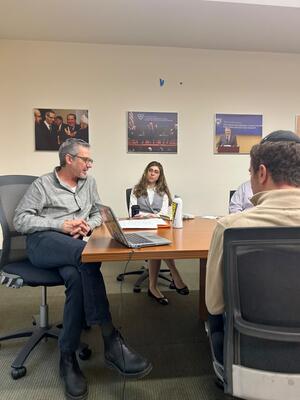
An alternative then emerged in Tasmania. Dr. Rovner explained how Melbourne journalist Linka Isaacson wrote to Steinberg in 1940, proposing the island as a potential Jewish settlement. After further meetings with Tasmanian officials, Premier Robert Cosgrove signed a memorandum stating that his government “accepts in principle the proposal that a settlement of Jewish migrants should be established in Tasmania.” Critchley Parker Jr., a young, non-Jewish Australian with strong political connections, was sent alone to survey the remote wilderness on foot but encountered violent weather and ran out of supplies, ultimately dying of starvation and exposure. In his final days, he sketched a blueprint for the settlement and wrote to Steinberg that “to die in the service of so noble a cause is to me a great satisfaction.” Dr. Rovner closed with a haunting detail: the Library of Tasmania’s immigration registry for 1940 to 1943 is “entirely blank—it’s an empty volume.”
In the Q&A, students asked whether the settlements could have saved Jews from Europe. Dr. Rovner answered that “the likelihood was very minimal,” given the sheer length of the voyage to Australia, but added that even Ze’ev Jabotinsky, after flying over the territority once offered to the Zionists in East Africa, reconsidered his position and later praised Steinberg, as both the territorialists and Revisionists prioritized saving lives.
Another student asked how much these writers perceived Australia as an ideal over Israel. Dr. Rovner pointed to Zionism’s triumph of imagination, which allowed Jews in the diaspora to “imagine a place they’d never been to” as home. Yet he noted that these territorialists, despite their poetic enthusiasm, failed “to make all these other places seem like home.” He noted that Eliezer Ben-Yehuda himself had backed the Uganda Plan, and that a Hebrew journal in 1930s Tel Aviv had even published a piece suggesting Jews leave for Australia.
Dr. Rovner’s lecture ultimately showed that the territorialist dream of an Australian refuge, though driven by urgent humanitarian motives, was undone by war, distance, and the movement’s inability to make an unfamiliar land feel like home. These plans reveal how much a homeland depends on imagination and attachment as well as political approval, a strength that Zionism possessed, and that territorialists could not replicate. Yet the story endures as a testament to lengths to which figures like Steinberg and Parker were willing to go in the service of saving lives, and asks, even today, what could have been if they had succeeded.