By Dave DeFusco
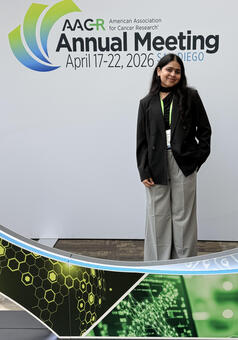
When Komalpreet Kaur presented her colorectal cancer research at the annual meeting of the American Association for Cancer Research in San Diego in April, she was sharing findings that could help scientists better understand why some of the disease's most treatment-resistant tumors survive therapy.
As a student in the Katz School's M.S. in Biotechnology Management and Entrepreneurship, Kaur conducted the research in the laboratory of Dr. Radhashree Maitra on Yeshiva University's Wilf Campus, where she investigated how colorectal cancer cells respond when a protein called PRMT5 is blocked.
The research focuses on tumors with mutations in a gene called KRAS, which is found in about 45% of people with colorectal cancer. These mutations help drive cancer growth but have historically been difficult to target with drugs. Instead of attacking KRAS directly, researchers are looking for other weak points that cancer cells depend on to survive.
One promising target is a protein called PRMT5, which is found at unusually high levels in about 75% of colorectal tumors. PRMT5 helps control how cells use genetic information to make proteins. Earlier research suggested that blocking PRMT5 could weaken cancers with KRAS mutations, but scientists did not fully understand how the protein interacts with KRAS or why some cancer cells resist treatment.
Working in Dr. Maitra’s laboratory, which also benefited from input provided during its early stages by Dr. Sanjay Goel of the Rutgers Cancer Institute, Kaur and the research team studied what happens when PRMT5 is blocked in colorectal cancer cells grown in the laboratory.
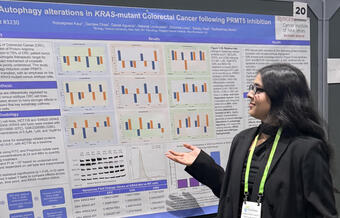
“Our goal was to understand what happens inside cancer cells when PRMT5 is blocked,” said Kaur. “We wanted to learn whether these treatments push the cells toward death or whether the cells activate survival mechanisms that allow them to resist treatment. Understanding that difference could help researchers design more effective therapies for patients with KRAS-mutant colorectal cancer.”
The researchers compared four colorectal cancer cell lines. Two carried KRAS mutations, while two did not. The cells were treated with three different PRMT5-blocking drugs—EPZ015666, GSK3326595 and AMG-193—at several doses and examined after 24 and 48 hours.
A major focus of the study was autophagy, the cell’s natural recycling system. Healthy cells use autophagy to break down damaged parts and reuse them for energy, especially during times of stress. Cancer cells, however, can turn that same process into a survival tool, allowing them to recover from the damage caused by treatment instead of dying.
The team also measured apoptosis, a natural process in which damaged or unhealthy cells destroy themselves. Many cancer treatments work by triggering apoptosis, preventing cancer cells from continuing to grow.
The researchers found a clear difference between cells with KRAS mutations and those without them. The KRAS-mutant cells showed much stronger changes in proteins involved in autophagy, suggesting they were activating their recycling system after PRMT5 was blocked. At the same time, those cells experienced lower levels of apoptosis than the cells without KRAS mutations. In other words, the KRAS-mutant cells appeared to rely on autophagy to help them survive treatment.
Each of the three drugs produced a different response. EPZ015666 caused an early increase in autophagy activity that later declined. GSK3326595 also triggered early activity but later reduced important proteins involved in the process. AMG-193 produced the strongest overall changes, especially at higher doses after 48 hours, making it the most powerful regulator of autophagy among the drugs tested.
The researchers also discovered that timing mattered. Some changes that appeared after 24 hours weakened or even reversed after 48 hours, showing that cancer cells adapt as they respond to treatment. Those shifting responses suggest that when a drug is given may be just as important as which drug is used.
“One of our most important findings was that KRAS-mutant cells showed stronger activation of autophagy but lower levels of cell death,” said Kaur. “That suggests these cells may be using autophagy as a protective mechanism. If future studies confirm this, combining a PRMT5 inhibitor with a drug that blocks autophagy could become a promising strategy to make these cancers more vulnerable to treatment.”