By Dave DeFusco
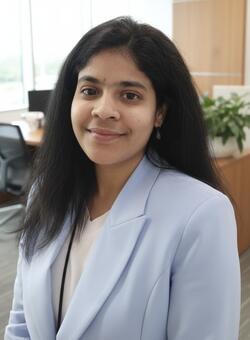
When Venkatalakshmi Kottapalli earned her M.S. in Artificial Intelligence from the Katz School in December, she wasn’t just completing a degree, she was preparing to help change how new medicines reach patients. Now an Associate AI Engineer at Bloqcube, she is applying her training to modernize clinical trials—the critical testing process that determines whether treatments are safe and effective. Her work sits at the intersection of technology and human health, where smarter systems can mean faster breakthroughs and, ultimately, saved lives.
At Bloqcube, she develops “agentic AI” systems, which are smart software tools made up of digital “agents,” each responsible for a specific task. In clinical trials, many steps are still done manually. Clinical monitors often travel to research sites to review paperwork, check whether rules are being followed and ensure patients are treated safely. This process can take months.
“What if we could automate much of that monitoring?,” said Kottapalli. “Instead of visiting one site at a time, AI agents can review information from multiple sites at once and flag anything that needs attention. That means trials can move faster and patients can get medicines sooner.”
Her role requires more than technical skill. Clinical trials are tightly regulated to protect patient privacy and safety, and healthcare data must follow strict rules, including HIPAA regulations in the United States. Kottapalli works closely with cross-functional teams to make sure the AI systems that she helps design are secure and compliant.
“At the Katz School, we didn’t just build models,” she said. “We worked on real-world problems. That prepared me to think about security, ethics and how AI fits into larger systems. Now at Bloqcube, I’m applying exactly what I learned.”
One of the most important experiences during her AI master’s program was her research on making large AI models more efficient. Many advanced AI systems require enormous computing power, which can be expensive and time-consuming. Working with her professor, she explored a mathematical method called Kalman filtering to make it easier to adapt large models to new tasks.
“Today, every industry wants to use large AI models, but fine-tuning them can take a lot of time, memory and cost,” she said. “Our method reduced compute usage by 42% and memory by 38%, and it trained almost twice as fast. That means companies can use AI in a more affordable way.”
This focus on efficiency is directly relevant to her current work. In healthcare technology, organizations must balance innovation with cost and reliability. By designing systems that use fewer resources, she helps make advanced tools more practical for real-world use.
During her time at the Katz School, Kottapalli built more than 28 end-to-end AI projects, working with machine learning, natural language processing and computer vision. She earned a certificate of excellence in machine learning for creating a fraud detection system that could identify suspicious claims.
“That project taught me how to take an idea from start to finish,” she said. “It’s not just about building a model. It’s about understanding the problem, preparing the data, testing the system and presenting the results clearly.”
Communication remains a key part of her job. At Bloqcube, she creates visual dashboards using tools like Tableau so that clinical professionals who may not have a technical background can easily understand AI-generated insights.
“User experience is very important,” she said. “If people cannot understand what the system is showing, then the technology will not help them.”
Kottapalli credits her professors and mentors for shaping her technical skills and her confidence. “The Katz School program gave me a strong foundation in AI, but it also gave me confidence to present my work and collaborate with teams,” she said. “There was never a time I felt unsupported.”