By Dave DeFusco
A Katz School student team’s idea to use artificial intelligence and blockchain to speed up disaster relief was named one of 15 finalists among more than 2,400 participants worldwide at the recent ARC x USDC Hackathon in New York City, earning praise from judges and mentors for its clear focus on delivering emergency aid faster.
The hackathon, held at Jay Conference Chelsea, challenged teams to tackle one of three focus areas: actions recorded on blockchains, payments for real-world assets or payments for digital content. Sushanth Arunachalam and Dhwani Patel, both students in the M.S. in Artificial Intelligence, chose to focus on payments for real-world assets—a decision rooted in personal experience for Patel, who grew up in India witnessing how earthquakes and floods can disrupt entire regions.
“In disasters, it’s not about whether money exists,” she said. “It’s about whether help arrives in time.”
When power and mobile networks go down, even people who have money in their bank accounts may not be able to access it. With fewer people carrying cash, basic needs like food or medicine can suddenly become unreachable. That real-world frustration became the motivation behind their project, called AidArc—ARC x USDC Relief Portal.
AidArc is a disaster relief platform designed to send financial help quickly, securely and transparently to people affected by emergencies. Instead of relying on slow paperwork or manual approvals, AidArc uses AI to review requests and blockchain technology to move money directly to victims.
Blockchain is a shared digital record that anyone can verify but no one can secretly change. The team used USDC, a digital dollar backed by real currency, and Circle’s Arc blockchain, which allows funds to be sent almost instantly and tracked clearly. The goal was to make sure aid reaches the right people fast and that every dollar can be accounted for.

When a disaster occurs, an organization such as a government agency or nonprofit can define the affected area digitally, using location boundaries called geofencing. People inside that area can submit a request for help through a simple online portal.
The system automatically checks the person’s location and basic details. An AI model reviews the request and decides whether it fits the rules—for example, whether the request is coming from within the disaster zone and whether the amount requested is reasonable. Smaller requests can be approved automatically. Larger or unusual ones are flagged for human review, keeping people involved where judgment matters most.
Once approved, the money is sent directly to the person’s digital wallet in USDC. Every transaction is recorded on the blockchain, creating a clear trail that donors, NGOs and governments can review later.
Arunachalam and Patel built AidArc, which is still a prototype, in just two intense days. Both specialize in AI, not blockchain, so they had to learn an entirely new system while coding their solution. They faced technical challenges, including confusing documentation and authentication errors. At one point, a single incorrect key delayed them for hours until a fresh look solved the problem. Despite the pressure, they delivered a working demonstration that showed money moving from one wallet to another in real time.
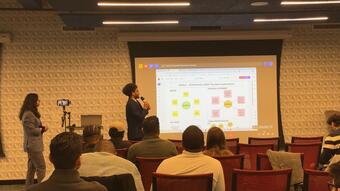
Presenting AidArc live to judges and mentors was a major milestone. Feedback focused on security and responsibility, especially the importance of keeping human oversight when money is involved. The judges praised the project for addressing a global problem with a modern approach and encouraged the team to strengthen safeguards as the system evolves.
For Arunachalam, the experience changed how he thinks about technology. “We saw how AI and programmable finance can work together to solve problems that affect millions,” he said.
For Patel, the project reaffirmed why she chose this field. “If technology can reduce stress and help people survive disasters faster, then it’s worth building,” she said.